Maruti Suzuki Vendor Conference 2026: Event, Suppliers and Automotive Industry Guide
Maruti Suzuki convenes an annual, closed-door conference for the component suppliers and vendor partners that feed its plants. The 2026 edition was held at Bharat Mandapam in New Delhi in May. This guide sets out what is on the record about the conference, what Maruti Suzuki publishes about its own manufacturing and supplier base, and — in Section 08 only — the DigiLib AI avatar HoloBox911 ran there. It is a separate event from MQFC 2.0, and nothing from one is attributed to the other. Where a fact rests on a single source, or on a supplier's account rather than the organiser's, the page says so.
HoloBox911 editorial · Researched and published 9 October 2026
The Vendor Conference 2026 at a glance
What is the Maruti Suzuki Vendor Conference?
The Vendor Conference is an annual gathering Maruti Suzuki India Limited convenes for the companies that supply it. Event listings describe it as a closed-door business event for the carmaker's component suppliers and vendor partners, not a public trade fair: there is no ticketed hall, no visiting public, and the audience is there by invitation because it already sells into Maruti Suzuki or wants to. The 2025 edition is independently attested — the component maker Subros published a note on 28 April 2025 recording its participation and describing the conference as a platform bringing together key partners from across the automotive supply ecosystem — which establishes the series rather than any one year's detail.
The reason a carmaker holds one is structural. A modern passenger vehicle is assembled from components almost all of which are made by somebody else, and the carmaker's quality, cost and launch timing are therefore only as good as the hundreds of firms behind them. A conference of this kind is where annual targets are set out to that base at once: quality standards for the year ahead, localisation expectations, cost and delivery commitments, the model and technology roadmap suppliers need to tool up for, and recognition for the firms that performed. Doing it in one room, once a year, is cheaper and clearer than doing it in hundreds of separate meetings.
One point of definition before going further, because it is the most common error made about this event. The Vendor Conference is not MQFC 2.0, which is a separate Maruti Suzuki event covered in its own guide on this site, and it is not the ACMA–Maruti Suzuki Supplier Development Conference, a third event held on 10 July 2026 at Gurugram in partnership with the Automotive Component Manufacturers Association. The three have different dates, venues, formats and audiences. Nothing on this page — no date, figure, photograph or deployment detail — is carried across from either of the others.
What a supplier conference is for
The published description of this conference names supply chain excellence, quality benchmarks, localisation targets and alignment with the company's production and technology roadmap. Those four map onto what supplier conferences across the industry are built to do:
- Set the quality bar for the year — defect targets, warranty performance and the audit regime suppliers will be measured against.
- State localisation expectations — which parts the carmaker wants sourced domestically, and on what timetable, so suppliers can plan investment.
- Share the roadmap — the models, powertrains and technologies coming, which determines what a supplier must be able to make in two or three years' time.
- Recognise performance — supplier awards are a standard feature of these events across the industry, though no award list has been published for this edition and none is described here.
- Let suppliers reach the carmaker — a vendor with a question about process, documentation or an internal project normally has to find the right person and a free slot in their diary. A conference compresses that into a day.
Vendor Conference 2026 date and programme
The month is settled: May 2026. The number of days is not, and this guide sets the conflict out rather than smoothing it over. A third-party events directory lists the conference as running 21 to 23 May 2026, three days, at Bharat Mandapam. The HoloBox911 case study for this event refers in one place to a two-day conference on 21–22 May 2026, and elsewhere describes its own deployment as a single day — “one box, two jobs, one day”. Those are not necessarily in conflict on the deployment point: a one-day installation inside a multi-day conference is ordinary. They are in conflict on the conference's own length. Maruti Suzuki has published no programme, agenda or press release for the 2026 edition that would settle it, so no session, speaker or timing is stated anywhere on this page.
| What is on record | Detail and source |
|---|---|
| Dates and duration | 21–23 May 2026, three days, per a third-party events directory, which also gives Bharat Mandapam as the venue and Maruti Suzuki India Ltd. as the convenor. The HoloBox911 case study instead refers to a two-day conference on 21–22 May 2026. The HoloBox911 deployment itself is described as occupying one day. No opening or closing times are published by anyone, and none are stated here. Readers needing the exact dates should take them from Maruti Suzuki directly. |
| Programme and format | Described as a closed-door business gathering for component suppliers and vendor partners, covering supply chain excellence, quality benchmarks, localisation targets and alignment with the production and technology roadmap. The directory's own schedule field reads “Not Available Yet” and no keynote speakers are listed. Entry is shown as free, which for a closed-door company event should be read as “no ticket price” rather than “open to the public”. No agenda, session list or speaker line-up has been published. |
Venue: Bharat Mandapam, New Delhi
The Vendor Conference 2026 was held at Bharat Mandapam, the convention centre at the Pragati Maidan complex in New Delhi. This is the one event-specific detail with two independent sources behind it: the events directory names Bharat Mandapam (Pragati Maidan), New Delhi, and the HoloBox911 case study independently places its deployment “at Bharat Mandapam”. Bharat Mandapam is the redeveloped convention and exhibition complex in central Delhi, used for large conferences, state events and trade exhibitions, and it is a conventional choice for a thousand-delegate corporate conference. Beyond the venue itself, this guide states nothing: no hall or room number, no floor plan, no registration desk arrangements, no parking or metro guidance has been published for this event, and none is reconstructed here. Because the conference is closed-door, there is no public visitor information to give — attendance is by Maruti Suzuki's invitation, and suppliers should take joining details from their own Maruti Suzuki contact rather than from any published source.
Maruti Suzuki: company and automotive operations
Maruti Suzuki India Limited is India's largest passenger vehicle manufacturer and a subsidiary of Japan's Suzuki Motor Corporation. The figures in this section come from the company's own published releases, with the reporting period attached to each. They describe Maruti Suzuki, not the conference, and the two sets of numbers are kept apart throughout this guide.
Manufacturing footprint and capacity
The company operates four manufacturing facilities: Gurugram, Manesar and Kharkhoda in Haryana, and Hansalpur in Gujarat. Together they carry an installed annual capacity of about 24 lakh units. With FY2025-26 production at 23.4 lakh units, the company ran close to that installed ceiling for the year, which is the practical reason capacity expansion and supplier readiness dominate its supply-chain agenda. In March 2026 Maruti Suzuki identified land for a fifth facility at Khoraj Industrial Estate in Sanand, Gujarat, which the company says will have an annual capacity of 10 lakh units once fully operational, as part of a stated ambition to reach roughly 40 lakh units a year. A capacity plan on that scale is also a supplier plan: components have to be available in the same volumes, from firms that have tooled up in advance.
Production and products
In its April 2026 release the company reported an all-time high of over 23.4 lakh units produced in FY2025-26, an increase of 11.66% on the previous financial year. It described itself as the only Indian passenger vehicle maker to reach that volume, and the only manufacturing location in Suzuki Motor Corporation's global network to do so. Five individual models each crossed 2 lakh units in the year: the Dzire, Fronx, Swift, Ertiga and Baleno. The product range spans small hatchbacks through compact SUVs and MPVs, and the company sells through separate retail channels in India as well as exporting.
The supply chain and supplier network
Maruti Suzuki buys the great majority of what goes into its vehicles from external component manufacturers, many of them clustered around its Haryana and Gujarat plants to keep inbound logistics short. Publicly identifiable suppliers include Subros, which makes vehicle air-conditioning systems and has publicly recorded its participation in this conference series, and Rane Group companies, which supply steering and related systems. In its FY2025-26 production announcement the company's leadership credited the support of employees, suppliers and dealer partners for the record output. What Maruti Suzuki does not publish is a supplier count, a tier-wise breakdown or a localisation percentage, so no such figure appears on this page — anyone citing one should ask the company for its source.
Quality management, technology and innovation
Volume at this scale only works if quality is controlled upstream. A defect that reaches final assembly from a tier-one supplier is expensive; one that reaches a customer is far more so, which is why quality benchmarks are named in the conference's own published description alongside supply chain and localisation. The themes a carmaker brings to its suppliers under this heading are consistent across the industry: supplier quality assurance and audit, defect and warranty tracking back to source, process capability on the supplier's own line, and increasingly the digital systems that carry that information in both directions. The specific standards, targets and programmes Maruti Suzuki set at the 2026 conference have not been published, and none is described here.
The supplier ecosystem and the automotive industry
A note on what follows: this section explains the general structure of automotive component supply that a conference of this kind addresses. It is not a record of what was said at the 2026 edition. Only four themes are on the record for this conference — supply chain excellence, quality benchmarks, localisation targets, and alignment with the production and technology roadmap — and where the text below corresponds to one of those, it is said explicitly. Everything else is industry background for a reader new to the sector, and must not be read as a claim about what Maruti Suzuki told its suppliers.
Component suppliers and the tier structure
Automotive supply is organised in tiers. A tier-one supplier ships a finished assembly straight to the carmaker's line — a seat, a steering system, an air-conditioning module. Tier two makes the parts that go into those assemblies, tier three the raw and semi-finished material beneath them. The carmaker contracts with tier one, but a failure anywhere down the chain surfaces as its problem, which is why supplier conferences address not only direct vendors but the practices they in turn impose on their own suppliers. In India this base is substantial and long-established; the Automotive Component Manufacturers Association is its industry body, and co-hosts a separate supplier development conference with Maruti Suzuki, distinct from this event.
Vendor development, localisation and supply-chain efficiency
Two of the conference's four published themes sit here. Localisation means moving the manufacture of a part from an imported source to a domestic one — it shortens lead times, removes currency and freight exposure, and in India carries policy weight as well. It is slow work: a supplier must invest in tooling and prove quality before a single part ships, which is precisely why a carmaker states targets a year or more ahead at an event like this. Vendor development is the support side of the same coin, the engineering and process help a carmaker gives a supplier to get there. Supply-chain efficiency covers what happens once parts flow: inbound logistics, inventory held against line stoppage, and the planning systems that keep a plant running near capacity — which, at 23.4 lakh units against 24 lakh of installed capacity, is exactly where Maruti Suzuki was operating in FY2025-26.
Digital transformation, sustainability and responsible sourcing
Digital transformation in this context is mostly unglamorous: supplier portals, shared quality and traceability data, document and knowledge systems that let a vendor find an answer without booking a meeting. The DigiLib knowledge base referred to in Section 08 is an instance of that kind of internal system. Sustainability and responsible sourcing are a newer and increasingly contractual layer — emissions and energy in the supplier's own operations, material provenance, and the reporting a carmaker now needs from its chain to satisfy its own disclosures. Both are live industry themes; neither is named in the published description of this conference, and this guide does not claim either was on its agenda.
Vendor Conference 2026 highlights
What the published record supports
Maruti Suzuki has issued no press release or post-event report for the 2026 Vendor Conference, and no trade coverage of it has been published. That limits what can honestly be called a highlight to the following, each drawn from a named source:
- Supplier engagement at scale — the event exists to put the carmaker in front of its whole vendor base at once, and the published description frames it exactly that way.
- Quality standards and localisation targets — both named in the event's own listing as focus areas, alongside supply chain excellence.
- Roadmap alignment — the listing describes strategic alignment with the carmaker's production and technology roadmap, the forward-looking half of a supplier conference.
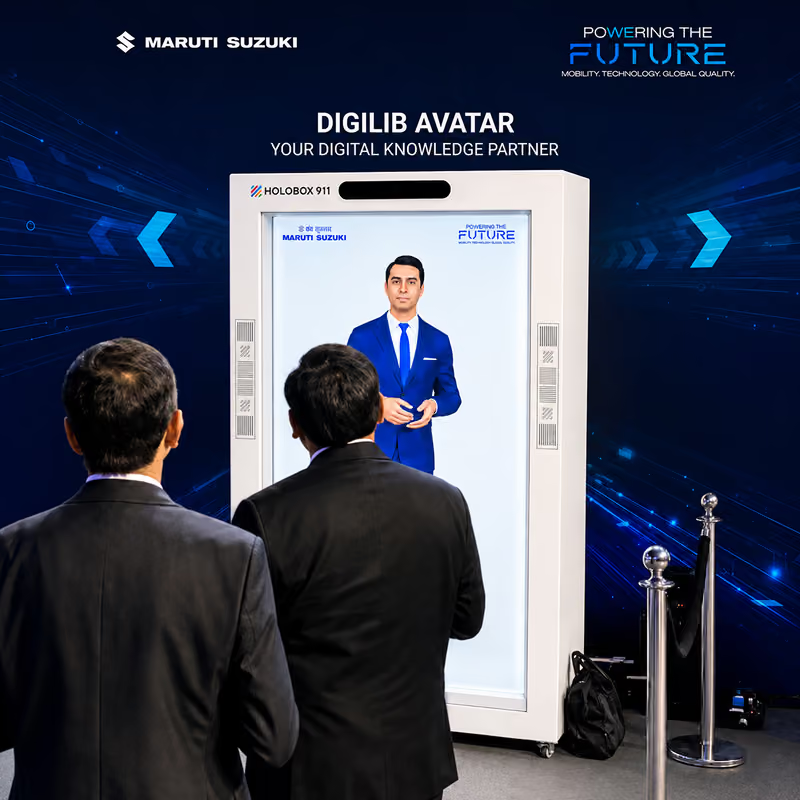
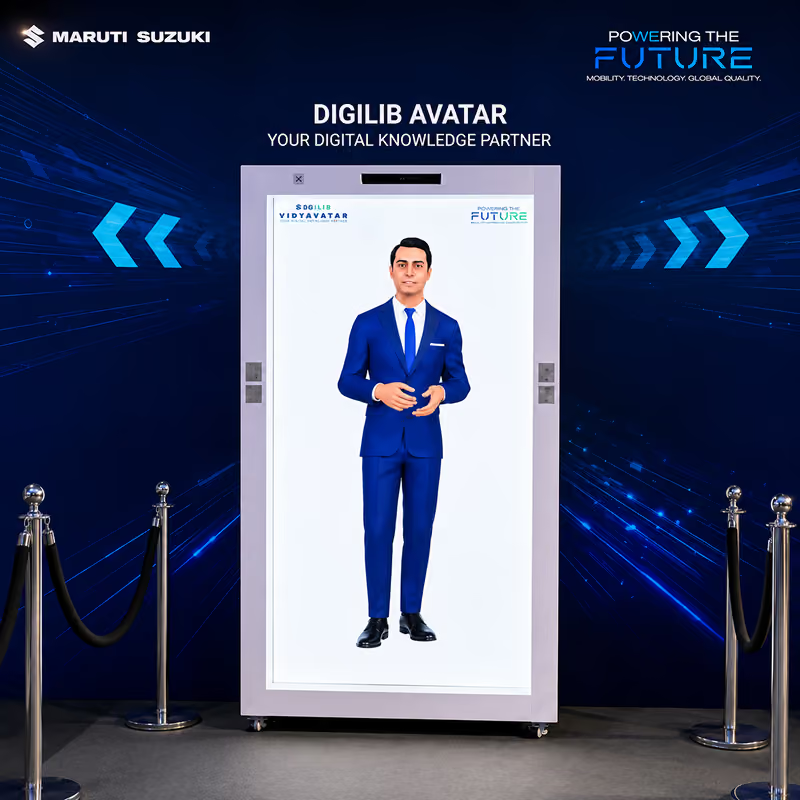
- Vendor knowledge sharing — the one element of the 2026 edition with a documented mechanism, through the DigiLib AI avatar described in Section 08. That account comes from HoloBox911 as the supplier of the installation, not from Maruti Suzuki.
Where the record stops
It is worth being explicit about the line between the two, because supplier conferences routinely generate claims that are never documented:
- On the record: that the conference is an annual closed-door Maruti Suzuki event for its suppliers; that the 2026 edition took place in May at Bharat Mandapam; its four stated focus areas; and that a HoloBox911 installation ran on the floor.
- Not on the record: any supplier award or winner, any announcement or launch made at the event, any named speaker, any session title or time, any sourcing or localisation commitment agreed there, and any business outcome. None of these is invented or implied anywhere on this page.
Maruti Suzuki and the conference in numbers
Three kinds of number get mixed together whenever this event is written about, and they are kept strictly apart here. Maruti Suzuki's corporate figures come from the company's own releases and carry a reporting period. Conference-specific figures are reported by HoloBox911 as the supplier of one installation, not by the organiser, and are labelled as such. And one figure in circulation — 750+ DigiLib project records — describes the size of a knowledge base, not a count of questions answered; the two are not interchangeable and are never presented as one another on this page.
Every figure with its source and period
| Measure | Figure, source and reporting period |
|---|---|
| Vehicles produced | Over 23.4 lakh units in FY2025-26, an all-time high and an increase of 11.66% on FY2024-25 — Maruti Suzuki press release, April 2026. The company states it was the only Indian passenger vehicle manufacturer, and the only location in Suzuki Motor Corporation's global network, to reach that volume. |
| Installed annual capacity | About 24 lakh units a year across the four existing plants — current as reported alongside the FY2025-26 production figure. Output of 23.4 lakh against 24 lakh of capacity means the company ran close to its ceiling for the year. |
| Manufacturing plants | Four: Gurugram, Manesar and Kharkhoda in Haryana, and Hansalpur in Gujarat — as at FY2025-26. |
| Fifth plant and future capacity | Land identified in March 2026 at Khoraj Industrial Estate, Sanand, Gujarat, with a stated annual capacity of 10 lakh units once fully operational, within a stated ambition of roughly 40 lakh units a year. These are plans and ambitions, not current capacity, and are shown as such. |
| Models above 2 lakh units | Five in FY2025-26: Dzire, Fronx, Swift, Ertiga and Baleno. The company named the models that crossed the threshold but did not publish a figure for each, so no individual model volume is given here. |
| Supplier count and localisation | Not published. Maruti Suzuki does not release a supplier count, a tier-wise breakdown or a localisation percentage in the sources consulted for this guide, so none is stated. Individual suppliers such as Subros and Rane Group companies are publicly identifiable, but a list is not a count. |
| Conference attendance | 1,000+ vendors — HoloBox911-reported, not independently confirmed. Maruti Suzuki has published no attendance figure. The same sentence in the HoloBox911 case study also carries the contested two-day framing discussed in Section 02, so the figure should be read with that caveat attached. |
| DigiLib project records | 750+ project records exported from Maruti Suzuki's internal DigiLib and used to train the avatar — HoloBox911-reported. This is the size of the knowledge base the system could answer from. It is not a count of questions asked or answered: no figure for questions has been published by anyone, and the two must not be substituted for one another. |
| Languages at the deployment | English and Japanese — HoloBox911-reported. Plausible for a Suzuki group supplier event, but not independently confirmed, and stated here only with that attribution. |
The tiles and chart above show Maruti Suzuki's own corporate figures only. No conference figure is charted, because the only ones available are supplier-reported and have no published basis of measurement. Corporate and event numbers are never combined.