India's 1st
CE-Certified
Hologram
CERTIFIED
Company guide · Technology and consulting · Paris and India

Capgemini: Company Overview, Services, Technology, Innovation and India Operations

Capgemini is a Paris-headquartered business and technology transformation group, founded in Grenoble in 1967 and now describing itself as an AI-powered global business and technology transformation partner. It reported 2025 revenues of €22,465 million and operates in more than 50 countries, with close to 180,000 of its people in India. This guide covers the company's history, its services and technology capabilities, its Indian operations and Experience Centres, its published figures and its career disciplines. Every statistic carries its source and reporting period.

Compiled by the HoloBox911 team from Capgemini's own published results, press releases and corporate pages · Updated 9 October 2026
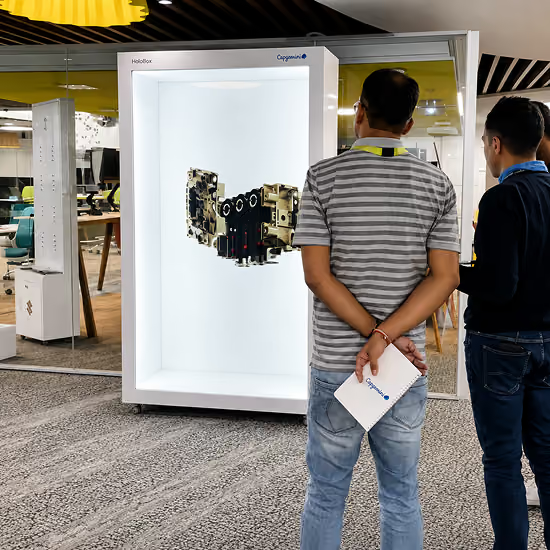
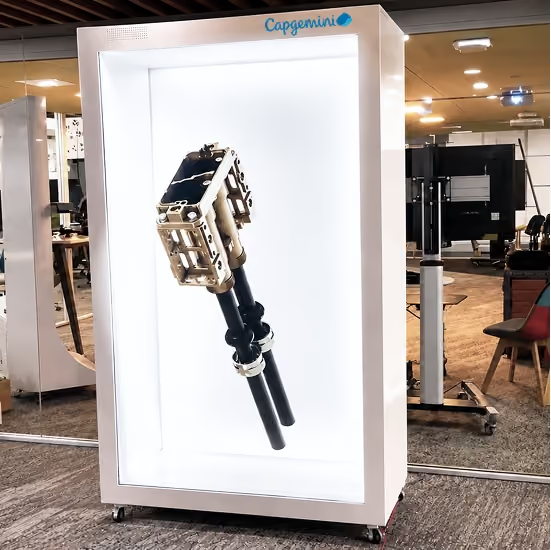
A HoloBox911 holographic display unit carrying a Capgemini logo on its bezel, installed in a Capgemini Experience Centre. Photograph supplied by HoloBox911.

Capgemini at a glance

CompanyCapgemini SEDescribes itself as “an AI-powered global business and technology transformation partner”.
Founded1967, GrenobleFounded by Serge Kampf as Sogeti. Capgemini cites “nearly 60 years of expertise” in its 2026 releases.
HeadquartersParis, FranceListed in Paris. Chief Executive Officer: Aiman Ezzat, in post since 2020.
2025 revenues€22,465 millionFull-year 2025, up 1.7% as reported and 3.4% at constant currency. Source: Capgemini FY2025 results.
People421,000Group headcount at 31 March 2026, the rise largely from integrating WNS. Capgemini's own boilerplate has used both “over 410,000” and “over 420,000” during 2026.
CountriesMore than 50As stated in Capgemini's 2026 corporate boilerplate.
India~180,000 across 13 citiesCapgemini India press release, July 2023. India is described as the Group's largest platform for innovation and delivery.
Implementation recordHoloBox911 at CapgeminiThe existing client case study for the Experience Centre holographic telepresence deployment.
BrandsFour named brandsCapgemini Engineering, Capgemini Invent, Sogeti by Capgemini and Frog Design.

What is Capgemini?

Capgemini is a business and technology transformation group headquartered in Paris and listed on the French market. Its own current description is "an AI-powered global business and technology transformation partner", and its stated purpose is "unleashing human energy through technology for an inclusive and sustainable future". Aiman Ezzat has been Chief Executive Officer since 2020.

In practice the company does three overlapping things. It advises organisations on what to change, which is consulting. It builds and runs the technology that delivers the change — applications, cloud platforms, data estates, security. And through Capgemini Engineering it does research and development work on the products its clients themselves sell, from software-defined vehicles to medical devices. The 2025 results describe the end-to-end capabilities as strategy, technology, engineering and intelligent operations.

The Group reported revenues of €22,465 million for 2025 and operates in more than 50 countries. Its headcount passed 420,000 during 2026, with India alone accounting for close to 180,000 people — a scale that makes the Indian operation central rather than peripheral, and which is covered in its own section below.

The brands, and what each one is for

Capgemini runs several named brands alongside the parent. Knowing which is which makes the company considerably easier to read, because a proposal, a job advert or a press release will often carry the brand rather than the group name.

  • Capgemini Engineering — the engineering and R&D business, launched as a brand in April 2021 following the Altran acquisition, with 52,000 engineers and scientists at launch.
  • Capgemini Invent — the strategy, design and transformation consulting arm.
  • Sogeti by Capgemini — carrying the name of the original 1967 company, focused on local technology services.
  • Frog Design — the product and experience design studio within the group.
  • The service portfolio Capgemini itself lists spans Cloud, Customer first, Cybersecurity, Data and AI, Digital sovereignty, Enterprise management, Intelligent industry and Sustainable business.

Capgemini history and major milestones

Capgemini's shape today is largely the product of acquisitions, and the two most consequential of them are recent. The timeline below carries only milestones that can be sourced with confidence. Several dates circulating online — the Ernst & Young Consulting acquisition year and the exact year of the single-word "Capgemini" rebrand among them — are reported inconsistently across sources, so they are left out rather than guessed at.

WhenWhat happened
1967–2016 — founding and first expansion1967: Serge Kampf founds Sogeti in Grenoble as an enterprise management and data processing company, reportedly from a converted two-room apartment; the Sogeti name survives today as a group brand. 1973: Sogeti takes a majority stake in CAP (Centre d'Analyse et de Programmation). 1975: the company becomes CAP Gemini Sogeti after acquiring the American firm Gemini Computer Systems. The 1980s bring a Paris stock-exchange listing. 2015: the acquisition of iGate completes, bringing a large Indian delivery base into the group, and from January 2016 iGate operates under the Capgemini brand alone.
2020–2025 — engineering, then operations1 April 2020: the Altran acquisition completes and is consolidated from that date, at a cash consideration of around €3.6 billion — the largest reshaping of the group's engineering capability. 2020: Aiman Ezzat becomes Chief Executive Officer. 8 April 2021: the "Capgemini Engineering" brand launches, bringing the engineering and R&D business together under one name with 52,000 engineers and scientists. 17 October 2025: the acquisition of WNS completes for a cash consideration of $3.3 billion, which Capgemini describes as creating a global leader in Agentic AI-powered Intelligent Operations; the Group's headcount rises to 421,000 by 31 March 2026 largely as a result.

Capgemini in India

India is the largest single concentration of Capgemini people anywhere. A company press release issued from Mumbai in July 2023 put the figure at close to 180,000 team members across thirteen cities — Bengaluru, Bhubaneswar, Chennai, Coimbatore, Gandhinagar, Gurugram, Hyderabad, Kolkata, Mumbai, Noida, Pune, Salem and Tiruchirappalli — and described India as the Group's largest platform for innovation and delivery, and as a strategic global innovation and delivery centre that also acts as a business platform through its Centers of Excellence. The same release named a 500-seat office at GIFT City in Gujarat, a modernised Talwade campus in Pune, a 5G Lab in Mumbai, a 6G research lab in Gurugram and an Energy Command Center in Bengaluru, with campuses in Noida and Mumbai running on renewable energy supported by on-site solar and battery storage. It also reported that women make up over 42% of the India workforce, that the company runs 53 Digital Academies, and that it has trained more than 75,000 young people in India. City-level figures published on Capgemini's India careers pages, which carry no date, put Bengaluru above 60,000 people across seven offices, Pune above 13,000 across Talwade, Chinchwad, Hinjewadi and Magarpatta, and Kolkata at 7,000 at Candor Tech Space. The Indian legal entity is Capgemini Technology Services India Limited, formerly iGate Global Solutions Limited. One clarification worth making early: Capgemini's corporate offices and delivery campuses are a separate matter from the two Experience Centres discussed in Section 08, and the two should not be conflated.

Capgemini services and business capabilities

Capgemini's 2025 results summarise its end-to-end capabilities as strategy, technology, engineering and intelligent operations. Its public service portfolio is listed in more granular terms: Cloud, Customer first, Cybersecurity, Data and AI, Digital sovereignty, Enterprise management, Intelligent industry and Sustainable business. The four groupings below organise that list rather than replacing it; the company's own terminology is kept throughout.

Strategy and transformation

The advisory end, delivered largely through Capgemini Invent: deciding what an organisation should change, what the business case is, and how the operating model has to move to support it. Frog Design sits alongside it for product and customer-experience design. This is also where the company's "Customer first" and "Sustainable business" offerings sit, which address commercial strategy and environmental obligations respectively.

Applications, cloud and enterprise management

The largest part of the business by volume: building, migrating and running the software estate. Capgemini lists Cloud and Enterprise management as distinct offerings, the latter covering the large packaged platforms — ERP, finance, supply chain — that most organisations run their operations on. Digital sovereignty is listed separately, reflecting European clients' requirements about where data sits and who can reach it.

Data, AI and cybersecurity

Data and AI is now the capability Capgemini leads with: its current corporate self-description is "an AI-powered global business and technology transformation partner", which is a positioning statement rather than a product list. Cybersecurity is a separate named offering covering the defensive side. These two tend to travel together in practice, because an AI programme creates data-governance and security obligations before it creates results.

Engineering, intelligent industry and intelligent operations

Capgemini Engineering works on the products clients sell rather than the systems they run on — R&D and engineering services across industries from automotive to life sciences. Intelligent industry is the company's term for applying digital technology to physical operations, where information technology meets operational technology. Intelligent operations, the newest of the four, is the business-process capability substantially expanded by the WNS acquisition in October 2025.

Technology and innovation at Capgemini

Capgemini describes itself as an AI-powered global business and technology transformation partner, and the company publishes its own portfolio under eight headings: Cloud; Customer first; Cybersecurity; Data and AI; Digital sovereignty; Enterprise management; Intelligent industry; and Sustainable business. The three groupings below follow that published terminology. They describe what Capgemini says it sells and delivers, not the wider technology market — where a capability belongs to a general industry trend rather than a named Capgemini offering, it is identified as such.

Data and AI, including generative AI

Data and AI is one of the eight portfolio areas Capgemini names, and the "AI-powered" framing in its own corporate description sits at the centre of how the group positions itself in 2026. In practice this grouping covers data platform and data engineering work, analytics and decision support, and the application of machine learning and generative AI inside client operations. Capgemini publishes research on enterprise AI adoption through the Capgemini Research Institute, and its consulting brand Capgemini Invent takes the strategy and design end of that work. Readers should note the distinction the company itself draws: generative AI is an active and heavily marketed capability area across the whole IT services industry, so a vendor's AI positioning is not by itself evidence of any particular client outcome. Capgemini's published FY2025 results describe growth returning in the second half of 2025, with Q4 2025 up 10.6% at constant currency, but the company does not break out revenue by individual technology such as generative AI, and no such split should be inferred.

Cloud, enterprise management and digital sovereignty

Cloud, Enterprise management and Digital sovereignty are three separate headings in Capgemini's published portfolio, and they are usually encountered together on a transformation programme. Cloud covers migration, platform engineering and the running of cloud estates; Enterprise management covers the large packaged-application and process estates that sit on top, including finance, supply chain and HR platforms, together with the automation applied to them. Digital sovereignty is the newest of the three as a named offering and reflects European client demand for data residency, jurisdictional control and sovereign cloud arrangements — a requirement driven by regulation rather than by technology alone. Capgemini's acquisition of WNS, completed on 17 October 2025 for USD 3.3 billion in cash, was presented by the company as creating a leader in what it calls intelligent operations, which extends this grouping further into the running of business processes rather than only the platforms beneath them.

Cybersecurity, intelligent industry and digital engineering

Cybersecurity and Intelligent industry are the remaining two technology headings, and both connect to the engineering side of the group. Capgemini Engineering, the brand launched on 8 April 2021 following the Altran acquisition, was announced with 52,000 engineers and scientists and brought research and development and product engineering services into the group alongside its IT work. Intelligent industry is the heading Capgemini uses for the convergence of that engineering capability with software and data — connected products, digital twins, industrial data platforms and the digital continuity between design, manufacturing and service. Cybersecurity spans the advisory, protection and monitoring work required across all of it, and increasingly covers operational technology as well as corporate IT. The group also publishes Sustainable business and Customer first as portfolio headings; both are delivery-led offerings rather than technologies, and are grouped here only for completeness.

Industries served and the role of Experience Centres

The industries Capgemini works in

Capgemini is organised to serve clients across most of the large regulated and industrial sectors, and its published sector coverage groups broadly into the four clusters below. The group reported revenues of EUR 22,465 million for FY2025, but it does not publish a public sector-by-sector revenue split in that release, so these clusters describe where Capgemini says it operates rather than how its revenue is distributed.

  • Manufacturing and mobility — automotive, aerospace and defence, industrial and heavy equipment, and the wider engineering supply chain, the sectors most directly served by Capgemini Engineering and the intelligent industry portfolio.
  • Financial services — banking, capital markets and insurance, where regulatory reporting, core platform modernisation and payments work dominate.
  • Energy, utilities and life sciences — including the Energy Command Center in Bengaluru named in Capgemini's July 2023 India announcement.
  • Consumer, retail, telecommunications, media and the public sector — the service and distribution industries, where customer experience platforms and large operational estates are the common thread.

What an innovation or client Experience Centre is for

Across the IT services industry, a client Experience Centre is a dedicated space built to show work rather than describe it: a place where a prospective or existing client can be walked through a reference architecture, see a prototype or digital twin running, and hold a workshop with the people who would deliver the programme. Capgemini's own July 2023 India announcement describes India as the group's largest platform for innovation and delivery and names specific facilities — a 5G Lab in Mumbai, a 6G research lab in Gurugram, the Energy Command Center in Bengaluru, a 500-seat office at GIFT City in Gujarat and the modernised Talwade campus in Pune. Those are the facilities Capgemini has itself put on the record. Because Capgemini does not publish a capability inventory for each individual Experience Centre, this guide draws the line explicitly:

  • Documented by Capgemini: the existence and general purpose of Capgemini innovation facilities and Centers of Excellence in India, and the named labs and campuses listed above, as stated in the company's July 2023 release.
  • Not documented, and not asserted here: the specific equipment, demonstration inventory or technical capability of any one Capgemini Experience Centre. The HoloBox911 deployment described in Section 08 is reported by HoloBox911 as its supplier and is kept separate from Capgemini's corporate offices and from the facilities named above; no capability is attributed to a particular city on the strength of it.

Capgemini in numbers

Every figure below carries its reporting period, because Capgemini's published numbers move between releases and two different headcount figures are in circulation during 2026. Financial figures are from the company's full-year 2025 results release; headcount is from the 2026 releases as dated; India figures are from Capgemini's own India announcement of 13 July 2023 and have not been restated here against any later period. Figures from different years are not combined.

€22,465m
Group revenues, full year 2025
13.3%
Operating margin, full year 2025 (€2,983m)
421,000
Group headcount at 31 March 2026
~180,000
India team members, as stated 13 July 2023

Revenue growth as Capgemini reported it

Percentage growth. Scale 0 to 12%. All three bars are growth rates, but two are annual and one is a single quarter — the period is on each bar.

FY2025, as reported+1.7%
FY2025, constant currency+3.4%
Q4 2025 only, constant currency+10.6%

Source: Capgemini full-year 2025 results release. The Q4 figure is a single quarter and is not an annual rate or a forecast.

How Capgemini states its headcount in 2026

People. Scale 0 to 450,000. Same measure, three different published statements — shown together only to make the wording explicit.

“over 410,000” — H1 2026 boilerplate410,000+
“more than 420,000” — FY2025 and Q1 2026 releases420,000+
421,000 — point in time, 31 March 2026421,000

The rise to 421,000 is attributed largely to integrating WNS, acquired 17 October 2025. The two rounded phrases are Capgemini’s own wording in different releases, not corrections of one another.

Published figures with their reporting periods

MeasureFigure, source and reporting period
Group revenuesEUR 22,465 million (about EUR 22.5 billion) — full year 2025, Capgemini FY2025 results release
Revenue growth+1.7% as reported and +3.4% at constant currency — full year 2025 versus full year 2024
Fourth-quarter growth+10.6% at constant currency — Q4 2025 only; not an annual rate and not a forecast
Operating margin13.3% of revenues, equal to EUR 2,983 million, stable year on year — full year 2025
Organic free cash flowEUR 1,949 million, stable year on year — full year 2025
Group headcount421,000 people — as at 31 March 2026 (Q1 2026 release), the increase largely from integrating WNS
Headcount as stated in company boilerplate"over 410,000 team members in more than 50 countries" — H1 2026 boilerplate; "more than 420,000 people" appears in the FY2025 and Q1 2026 releases. Both wordings are current Capgemini text for different releases and should be quoted with their release attached.
India headcount and footprintclose to 180,000 team members across 13 cities — Capgemini India announcement dated 13 July 2023; not restated for any later period
India workforce and skillswomen more than 42% of the India workforce; 53 Digital Academies; more than 75,000 youths trained — all from the 13 July 2023 India announcement

Two cautions apply to this table. First, the group headcount figure and the boilerplate wording are not interchangeable: 421,000 at 31 March 2026 is a point-in-time figure, while "over 410,000" and "more than 420,000" are rounded phrases used in different 2026 releases. Second, the India figures date from July 2023, and the release carrying them used Capgemini's 2022 group boilerplate; the India numbers are therefore reproduced on their own and are not combined with any FY2025 or 2026 group figure. Where Capgemini has not published a figure — for example revenue by industry, by country, or by technology such as generative AI — no estimate has been substituted.
Section 08 · Supplier-reported deployment

HoloBox911 at a Capgemini Experience Centre

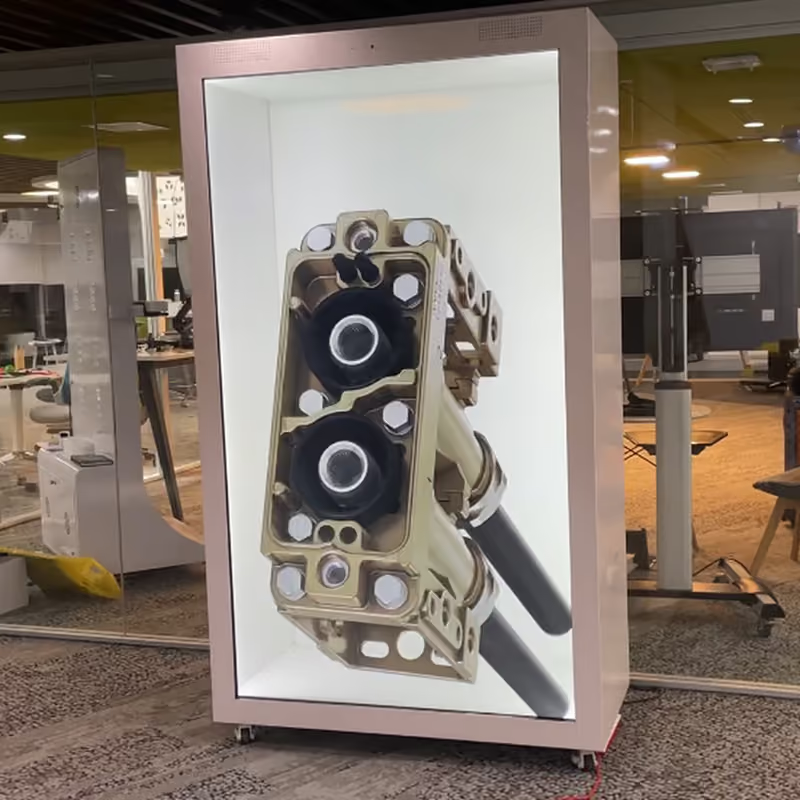
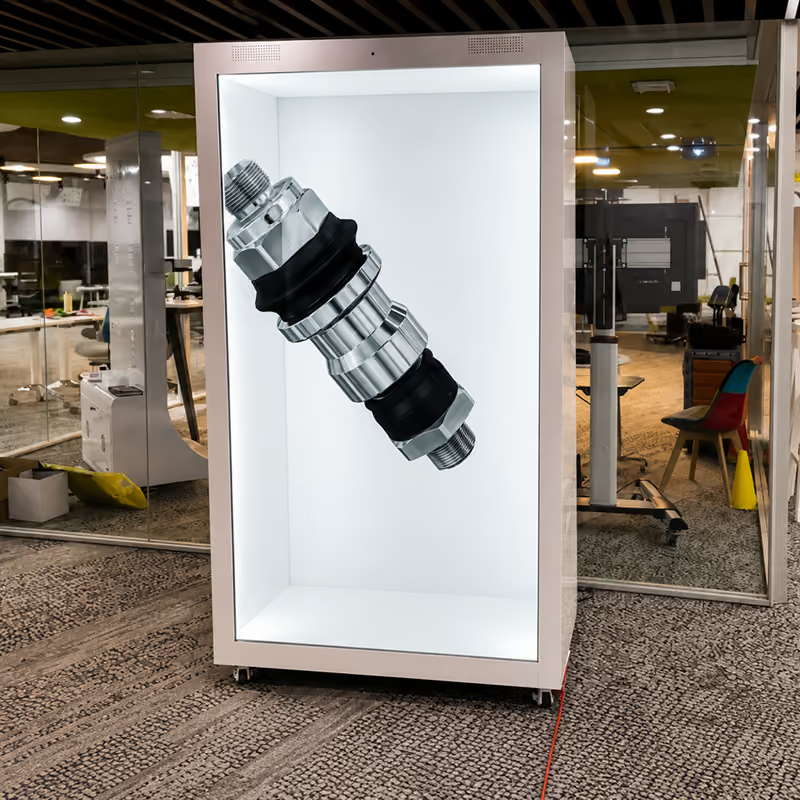
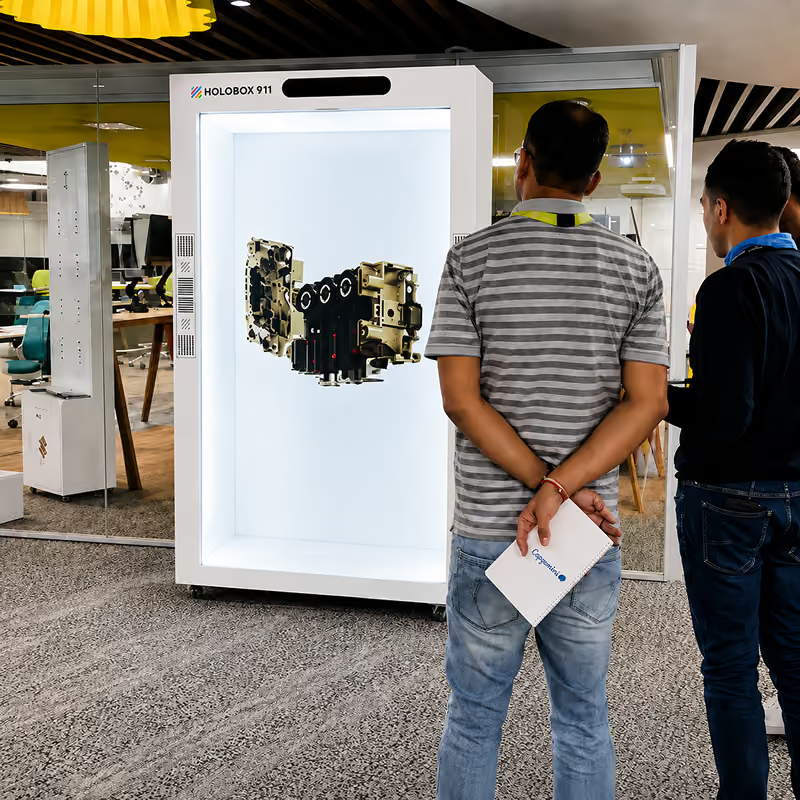
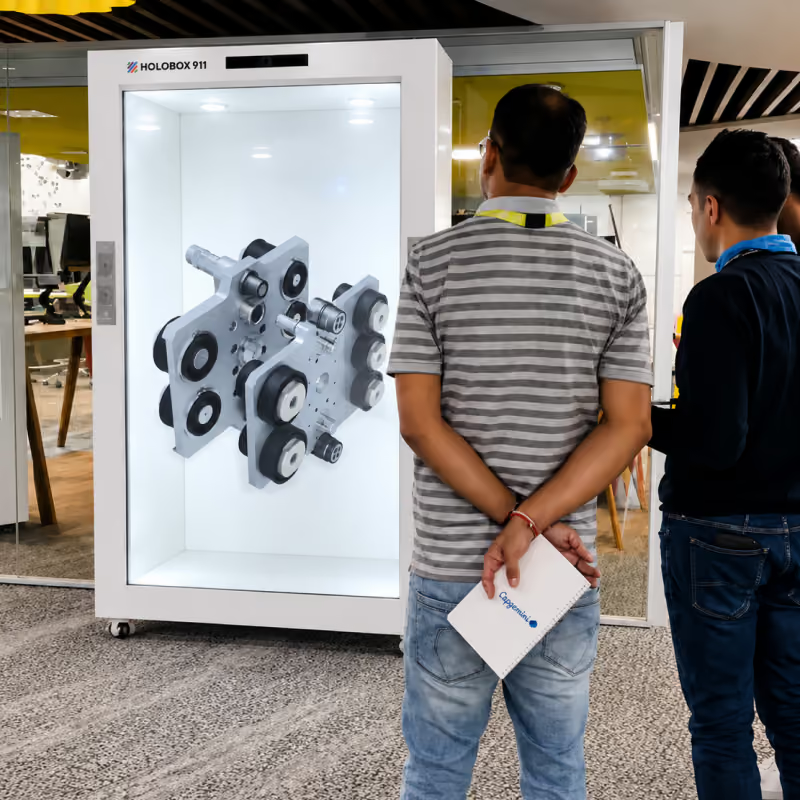
This is the one section of the guide about HoloBox911 rather than about Capgemini. HoloBox911 reports that two of its holographic display units were deployed with Capgemini Experience Centres in India, used to bring leadership based in France into the room at full height without headsets, glasses or a darkened room, and that it has handled capture, streaming and post-production since deployment. Those statements are reported by HoloBox911 as the supplier; they have not been independently corroborated and Capgemini has published no statement endorsing them, so they should be read as supplier-reported. The photographs below are genuine frames from a Capgemini Experience Centre showing the unit in use with engineering-component holograms. They are not evidence of the France telepresence use case, and no city, capability or equipment inventory is attributed to any individual Capgemini office or Experience Centre on the strength of them. The full deployment write-up is on the client case study. Explore the Capgemini HoloBox911 Case Study →

The HoloBox911 unit on the floor of a Capgemini Centre of Excellence Experience Centre, with staff viewing the display. Photograph supplied by HoloBox911.
01
Two Capgemini staff standing beside the holographic display unit in the open-plan Experience Centre. Photograph supplied by HoloBox911.
02
Closer view of the same unit, the Capgemini logo visible on the enclosure bezel. Photograph supplied by HoloBox911.
03
An engineering component shown as a hologram in the display, used for digital twin and engineering demonstrations. Photograph supplied by HoloBox911.
04
A new-format content pilot running on the unit in the same Experience Centre. Photograph supplied by HoloBox911.
05
1 / 5‹›

Careers, skills and future outlook

Capgemini recruits across consulting, software engineering, data and AI, cloud, cybersecurity and research and development engineering, and in India it also runs a large early-careers intake alongside experienced hiring. The company's own July 2023 India announcement describes the skills infrastructure behind that: 53 Digital Academies and more than 75,000 young people trained, with women making up over 42% of the India workforce. The group's published entity in India is Capgemini Technology Services India Limited, formerly iGate Global Solutions Limited, which is the name candidates will usually see on an offer. This guide does not list current vacancies, salary bands, interview formats or hiring timelines, and no recruitment outcome should be inferred from it — openings, locations and compensation are published only on Capgemini's own careers site and change continuously. Anyone applying should treat that site as the single authority and verify any recruiter contact against it.

On outlook, what can be said is what Capgemini has said. Its FY2025 results reported revenues of EUR 22,465 million with an operating margin of 13.3% and growth returning through the year, Q4 2025 reaching +10.6% at constant currency. Its two largest recent moves were structural rather than incremental: Altran, completed on 1 April 2020, which became Capgemini Engineering in April 2021 with 52,000 engineers and scientists; and WNS, completed on 17 October 2025 for USD 3.3 billion in cash, which the company presented as creating a leader in intelligent operations and which lifted group headcount to 421,000 by 31 March 2026. Read together, those point to a group extending from advising and building systems into engineering products and running operations. Beyond that, forward-looking statements are the company's to make: no growth rate, headcount target, hiring plan or market position is projected here that Capgemini has not itself published.

Section 10 · Frequently asked questions

Capgemini: 25 questions answered

Twenty-five questions in four groups. Twenty-three are about Capgemini itself — the company, its India operations, and its services and technology. Two, in the final group, cover the HoloBox911 deployment and are marked as supplier-reported. Every figure carries its reporting period, and where Capgemini has not published something it is stated as unpublished rather than estimated.

Group 1 · 7 questionsAbout Capgemini

What does Capgemini do?

Capgemini is a global professional services group working in consulting, technology and engineering. Its own current description is "an AI-powered global business and technology transformation partner", and its FY2025 release summarises its end-to-end capabilities as strategy, technology, engineering and intelligent operations. In practice that means advising clients on change, building and running their software and cloud estates, engineering their products, and increasingly operating their business processes for them.

When and where was Capgemini founded?

The company was founded in 1967 in Grenoble, France, by Serge Kampf, under the name Sogeti. It took a majority stake in CAP (Centre d'Analyse et de Programmation) in 1973 and was renamed CAP Gemini Sogeti following the acquisition of Gemini Computer Systems, reported in the mid-1970s. The exact year of the later rebrand to the single word "Capgemini" is given inconsistently across sources and is therefore not stated in this guide.

Where is Capgemini headquartered and who leads it?

Capgemini is headquartered in Paris, France, and is listed on the Paris stock exchange as a constituent of the CAC 40 index. Aiman Ezzat has been Chief Executive Officer since 2020.

How many people does Capgemini employ?

Group headcount was 421,000 as at 31 March 2026, reported in the Q1 2026 release, with the increase attributed largely to integrating WNS. Two rounded phrasings are in circulation in Capgemini's own 2026 communications: "over 410,000 team members in more than 50 countries" appears in the H1 2026 boilerplate, while "more than 420,000 people" appears in the FY2025 and Q1 2026 releases. Both are the company's own wording for different releases, so either should be quoted with its release attached rather than treated as a correction of the other.

What were Capgemini's most recent published results?

For the full year 2025 Capgemini reported revenues of EUR 22,465 million, up 1.7% as reported and 3.4% at constant currency, with an operating margin of 13.3% of revenues (EUR 2,983 million), stable year on year, and organic free cash flow of EUR 1,949 million, also stable. Growth strengthened through the year, with the fourth quarter of 2025 up 10.6% at constant currency — a quarterly figure, not an annual rate.

What brands does the Capgemini group operate?

Capgemini lists four brands alongside the group name: Capgemini Engineering for research and development and product engineering; Capgemini Invent for strategy, data and design consulting; Sogeti by Capgemini, which carries the original 1967 name; and Frog Design for design and innovation work.

What were Capgemini's largest recent acquisitions?

Two stand out. The acquisition of Altran completed on 1 April 2020, for approximately EUR 3.6 billion in cash, and was consolidated from that date; its capabilities were relaunched as the Capgemini Engineering brand on 8 April 2021 with 52,000 engineers and scientists. The acquisition of WNS completed on 17 October 2025 for USD 3.3 billion in cash, which Capgemini presented as creating a leader in intelligent operations. Earlier, the iGate acquisition completed in 2015 and was consolidated under a single Capgemini brand from January 2016.

Group 2 · 7 questionsCapgemini in India

How many people does Capgemini employ in India?

Capgemini's own India announcement dated 13 July 2023 states "close to 180,000 team members in India". That is the most recent India-specific figure the company has published in a release of this kind, and it is reproduced here with its July 2023 date attached. It has not been restated against any later period, and it should not be combined with the group headcount of 421,000 at 31 March 2026 to infer a current India number.

Which Indian cities does Capgemini operate in?

The July 2023 announcement names 13 cities: Bengaluru, Bhubaneswar, Chennai, Coimbatore, Gandhinagar, Gurugram, Hyderabad, Kolkata, Mumbai, Noida, Pune, Salem and Tiruchirappalli. These are corporate and delivery locations. They should not be read as a list of Experience Centres, which Capgemini does not enumerate city by city.

What is Capgemini's legal entity in India?

The principal Indian entity is Capgemini Technology Services India Limited, formerly iGate Global Solutions Limited — a renaming that followed the 2015 iGate acquisition. It is the name candidates and suppliers will usually encounter on contracts and offer letters.

What facilities and investments has Capgemini announced in India?

The 13 July 2023 announcement names a 500-seat office at GIFT City in Gujarat; a modernised Talwade campus in Pune with planned expansion; a 5G Lab in Mumbai; a 6G research lab in Gurugram; an Energy Command Center in Bengaluru; and campuses in Noida and Mumbai running on 100% renewable energy with on-site solar generation and battery storage. Those are the facilities Capgemini has itself put on the record; this guide adds none.

How large are Capgemini's biggest India locations?

Capgemini India careers pages give Bengaluru as more than 60,000 people across seven offices, Pune as more than 13,000 across the Talwade, Chinchwad, Hinjewadi and Magarpatta locations, and Kolkata as 7,000 at Candor Tech Space. These are undated snapshots from recruitment pages rather than figures from a dated release, and they are presented on that basis.

What does Capgemini publish about its India workforce and skills programmes?

From the same July 2023 announcement: women make up over 42% of the India workforce, the company runs 53 Digital Academies, and more than 75,000 young people have been trained through its skills programmes. Capgemini's India navigation also carries the line "25 years of Capgemini in India".

Is India Capgemini's largest location?

Capgemini describes India as the group's largest platform for innovation and delivery, and as a strategic global innovation and delivery centre operating as a business platform through Centers of Excellence. That is the company's own framing. Capgemini does not publish a country-by-country headcount or revenue table in its results releases, so a precise ranking of India against other countries cannot be sourced and is not asserted here.

Group 3 · 8 questionsServices and technology

What services does Capgemini actually sell?

Capgemini publishes its portfolio under eight headings: Cloud; Customer first; Cybersecurity; Data and AI; Digital sovereignty; Enterprise management; Intelligent industry; and Sustainable business. Its FY2025 release summarises the same portfolio as strategy, technology, engineering and intelligent operations. Anything outside those headings is a general market category rather than a named Capgemini offering.

What does Capgemini mean when it calls itself "AI-powered"?

It is the company's own corporate positioning: "an AI-powered global business and technology transformation partner". It signals that AI, including generative AI, is being applied both inside Capgemini's delivery and in what it sells to clients under the Data and AI heading. It is a statement of positioning rather than a measured claim — Capgemini does not break out revenue attributable to AI in its results, so no share of its EUR 22,465 million FY2025 revenues should be assigned to AI on the strength of that phrase.

What is Capgemini Engineering?

Capgemini Engineering is the group's brand for research and development and product engineering services. It was launched on 8 April 2021, following the Altran acquisition completed on 1 April 2020, and was announced with 52,000 engineers and scientists. It is the part of Capgemini that works on physical products and the software embedded in them, as distinct from corporate IT systems.

What is Capgemini Invent?

Capgemini Invent is the group's consulting, data and design brand — the front end of a transformation programme, where strategy and experience design are done before build and run. Frog Design sits alongside it for design and innovation work. Together they represent the "strategy" element of the four capabilities named in the FY2025 release.

What does Capgemini mean by "intelligent industry"?

Intelligent industry is one of the eight published portfolio headings and describes the convergence of engineering with software and data: connected products, digital twins, industrial data platforms, and digital continuity between design, manufacturing and after-sales service. It is the heading that most directly joins Capgemini Engineering's capability to the group's cloud and data work, and it is aimed principally at manufacturing, automotive, aerospace and industrial clients.

What is "intelligent operations", and how does the WNS acquisition fit?

Intelligent operations is the running of a client's business processes — finance, supply chain, customer operations — with automation and AI applied to them, rather than only building the systems that support those processes. Capgemini completed its acquisition of WNS on 17 October 2025 for USD 3.3 billion in cash and presented it as creating a leader in intelligent operations. The transaction also accounts for most of the rise in group headcount to 421,000 by 31 March 2026.

What is "digital sovereignty" and why is it a separate offering?

Digital sovereignty is a distinct heading in Capgemini's published portfolio and covers data residency, jurisdictional control over where and by whom data is processed, and sovereign cloud arrangements. It exists as a separate offering because the requirement is regulatory and contractual rather than purely technical — particularly for European public sector, defence, financial services and healthcare clients — and it therefore shapes architecture choices that a standard cloud migration would not have to make.

Which industries does Capgemini serve?

Broadly four clusters: manufacturing and mobility, including automotive, aerospace and defence and industrial equipment; financial services, covering banking, capital markets and insurance; energy, utilities and life sciences; and the consumer, retail, telecommunications, media and public sectors. Capgemini does not publish a revenue split by industry in its FY2025 release, so these describe where the group operates rather than how its revenue is distributed.

Group 4 · 3 questionsExperience Centres and the HoloBox911 deployment

What is a Capgemini Experience Centre for?

Across the industry, a client Experience Centre is a space built to demonstrate work rather than describe it: a client can be walked through a reference architecture, see a prototype or digital twin running, and hold a workshop with the delivery team. Capgemini names specific India facilities in its 13 July 2023 announcement — a 5G Lab in Mumbai, a 6G research lab in Gurugram, the Energy Command Center in Bengaluru, a 500-seat office at GIFT City and the modernised Talwade campus in Pune — but it does not publish a capability inventory for each individual Experience Centre, and none is inferred here.

What has HoloBox911 deployed with Capgemini?

HoloBox911 reports two holographic display units deployed with Capgemini Experience Centres in India, each an 86-inch 4K transparent LCD enclosure streaming at up to 2K over Ethernet, WiFi or 4G, with a capture rig that travels to the speaker and live chroma key removing the backdrop. The stated purpose is to bring leadership based in France into the room at full height, glasses-free, with no headsets and no darkened room, and HoloBox911 states it has handled capture, streaming and post-production since deployment and that both units still run. All of this is reported by HoloBox911 as the supplier. The full write-up is on the Capgemini client case study.

Has Capgemini confirmed or endorsed that deployment?

No. Capgemini has published no statement endorsing the deployment, and no partnership, endorsement or official quotation is claimed on its behalf anywhere in this guide. The deployment details are supplier-reported and have not been independently corroborated. The photographs in Section 08 are genuine frames from a Capgemini Experience Centre showing the unit in use with engineering-component holograms; they are not evidence of the France telepresence use case, and no capability is attributed to any particular Capgemini office or city on the strength of them.

We are here to help you! Contact us at +91 95601 32502 or email at sales@holobox911.com
IconPhoneChat on WhatsApp
Close

Bring Your Brand to Life with HoloBox911

Experience life-size, glasses-free 3D holographic experiences for events, exhibitions, retail, and business.
MecversityCTC
Life-Size 3D Holographic Display
Perfect for Events & Exhibitions
AI Avatar & Telepresence

Download the Brochure

Tell us about your requirement and our team will get in touch with you.
Download
Thank you for submitting your Details. Click on the link below to Download the Brochure
Download
Oops! Something went wrong while submitting the form.