Maritime XR Conclave 2026: Dates, Venue, Speakers and Event Guide
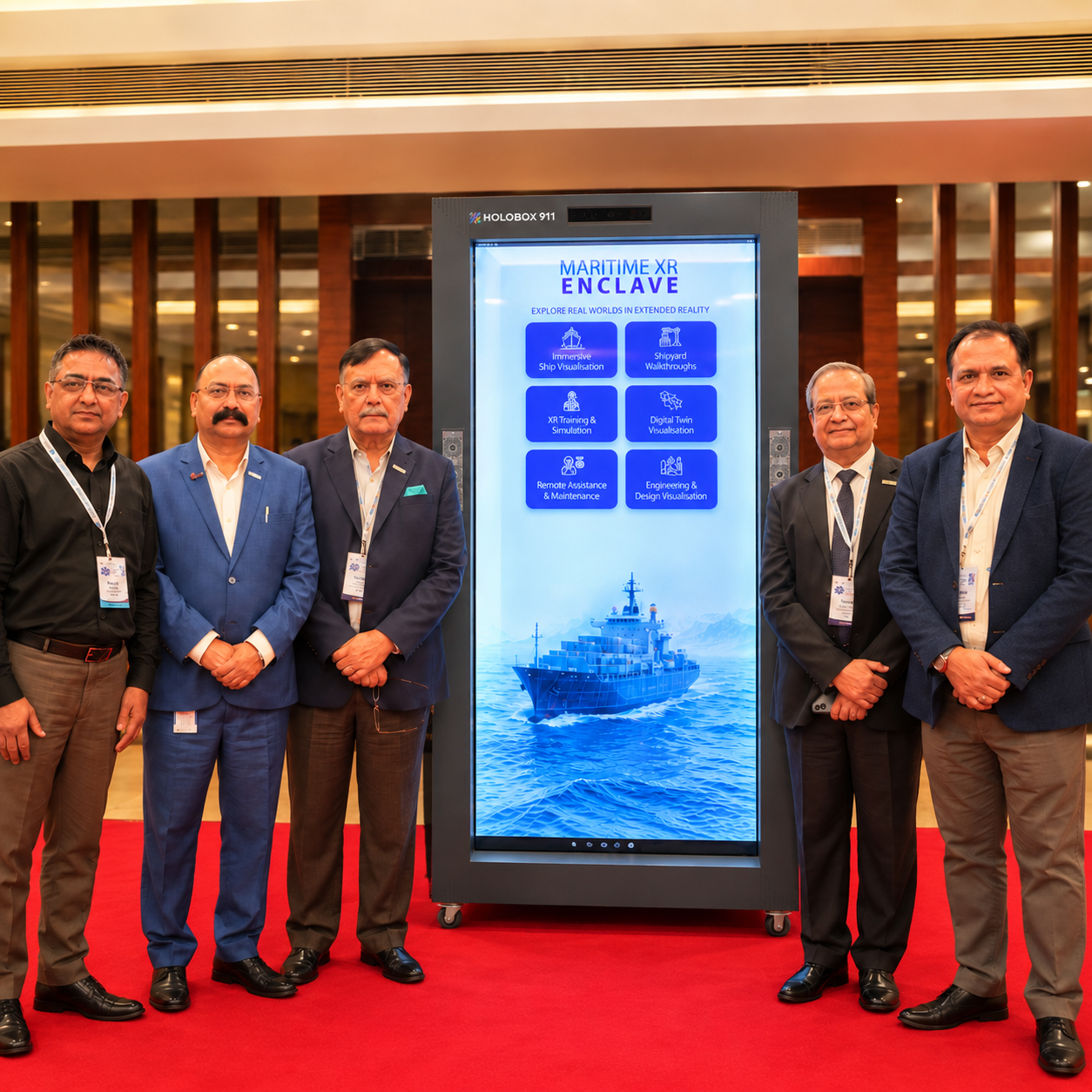
Maritime XR Conclave 2026 brought together maritime professionals, technology innovators, researchers and industry leaders at the Indian Register of Shipping in Powai, Mumbai. The event explored how extended reality, immersive simulation, digital twins and emerging technologies can transform maritime training, shipbuilding, engineering and operational collaboration.
HoloBox911 Events & Exhibitions guide · Compiled from the CEMS Academy official event listing, Indian Register of Shipping and the BIMCO–ICS Seafarer Workforce Report 2026 · Updated 8 October 2026
Maritime XR Conclave 2026 at a glance
What is Maritime XR Conclave 2026?
Maritime XR Conclave 2026 was a single-day industry gathering on extended reality in the maritime sector, held on Tuesday 22 September 2026 at the Indian Register of Shipping in Powai, Mumbai. It was organised by the Centre of Excellence in Maritime & Shipbuilding, which billed it under the line “Where Maritime Meets Extended Reality” and described it as a high-impact XR showcase where maritime innovation, immersive simulation and digital experience design meet the future.
The reason for holding it is a practical one. Maritime work is physically large, expensive to replicate and often dangerous to rehearse: a ship under construction, an engine room, a crane cab, a confined-space entry or an emergency on a moving vessel cannot be set up on demand for a classroom. Extended reality gives the industry a way to put people inside those environments without the ship, the shipyard or the risk. The conclave's stated purpose was to bring the two sides of that problem into one room — maritime organisations that own the training, engineering and inspection burden, and the technology providers building immersive tools.
The organisers set the focus on immersive training, digital engineering, smart operations and workforce transformation, applied across shipbuilding, operations, training, maintenance, inspection, engineering and workforce development. On the technology side the published scope covered virtual reality, augmented reality, mixed reality, digital twins, spatial computing and the industrial metaverse. The format was deliberately hands-on rather than lecture-only: alongside conference sessions, the programme was built around live demonstrations delegates could try themselves.
What the conclave offered
The organisers listed five elements for the day. These are the features they published, not a timed agenda:
- Live XR immersive demos — extended-reality experiences running on the floor for delegates to use
- Hands-on XR training — immersive training applied to maritime skills and procedures
- Live demonstrations — working systems shown by exhibiting technology providers
- Digital twin showcase — virtual replicas of vessels, systems and yard assets
- Strategic networking — structured time for maritime and technology participants to meet
Maritime XR Conclave 2026 dates and programme
The conclave ran for one day, on Tuesday 22 September 2026. The organisers did not publish a start time, a finish time or a session-by-session agenda; the official listing stated that the detailed schedule was being finalised. For that reason this guide does not present a timetable. What the organisers did confirm is the shape of the day: conference content from announced speakers, live extended-reality demonstrations and hands-on training stations, a digital twin showcase, and scheduled networking. Readers looking for a specific session time should treat the official CEMS listing and direct contact with the organisers as the only reliable source.
| Element | What the organisers published |
|---|---|
| Date and duration | Tuesday 22 September 2026, a single day, at the Indian Register of Shipping, Powai, Mumbai. No start or finish time was published. |
| Session timetable | Not published. The official listing said the detailed schedule was being finalised, and named programme elements — demos, hands-on training, a digital twin showcase and networking — without times. |
Where was Maritime XR Conclave 2026 held?
Maritime XR Conclave 2026 was held on the campus of the Indian Register of Shipping in Powai, in the north-east of Mumbai. IRS is India’s own ship classification society, established in 1975: it writes classification rules and surveys and certifies ships, offshore structures and marine equipment, both to its own rules and on behalf of flag administrations, and it is a member of the International Association of Classification Societies. The choice of venue is part of the story of the event. Holding an extended-reality conclave inside a classification society, rather than in a general exhibition hall, put the demonstrations directly in front of the surveyors, engineers and rule-makers who certify maritime assets — the people for whom a digital twin or an immersive inspection walkthrough has to stand up to scrutiny, not just look impressive. Powai itself is a long-established business and education district on the eastern side of the city, around Powai Lake and the Jogeshwari–Vikhroli Link Road, within a short drive of Chhatrapati Shivaji Maharaj International Airport; the nearest suburban railway stations are Kanjurmarg and Vikhroli on the Central line, and the area is otherwise reached by road. The organisers did not publish hall names, seating capacity, floor area or exhibition specifications for the conclave, and none are stated here.
Who organised Maritime XR Conclave 2026?
It helps to keep four roles apart, because they are easy to blur. The organiser was the Centre of Excellence in Maritime & Shipbuilding (CEMS). The venue host was the Indian Register of Shipping, on whose Powai campus the conclave was held. The title sponsor was a commercial technology company. The knowledge partners were a technology provider and a university research centre. The two organisations are closely linked — CEMS was set up by IRS — but the official listing credits CEMS as the organiser, and one preview article credited IRS and CEMS jointly.
Centre of Excellence in Maritime & Shipbuilding (CEMS)
CEMS is a maritime skills and design centre announced by the Indian Register of Shipping on 17 November 2017 as a special purpose vehicle formed with the Ministry of Shipping and Siemens Industry Software India, and operated by a Section 8 not-for-profit company. It runs two centres: one on the IRS campus in Mumbai and one at the Indian Maritime University in Visakhapatnam. Its work covers the design of commercial vessels for seagoing, coastal and inland waterway service, design support to Indian shipyards, and training in ship hull design, detailed design, maintenance and repair, product lifecycle management and digital manufacturing. The centre was reported at a project cost of about ₹766 crore, the large majority of it a Siemens in-kind grant, with a one-time Ministry grant of ₹50.07 crore towards machinery, classrooms, workshops and laboratories, and it is tied to the skill-gap objectives of the Sagarmala programme. Cost figures differ slightly between the 2017 announcement and a 2019 Ministry letter, and no source confirms a formal opening date, so this guide cites only the announcement. That background explains why CEMS, rather than a conference company, convened an XR conclave: immersive tools sit directly on top of the design, training and digital-manufacturing work it already does.
Indian Register of Shipping — venue host
IRS hosted the conclave on its Powai campus. It is India’s national ship classification society, established in 1975 and a member of the International Association of Classification Societies, and it surveys and certifies ships, offshore structures and marine products both to its own rules and on behalf of flag administrations. It also founded CEMS. Posts by participants named Arun Sharma, Executive Chairman of IRS, as Chairman of CEMS, and Rabindra Sah, Chief Technology Officer of IRS, as an adviser to CEMS — these come from LinkedIn posts rather than the official listing, and are presented here as reported rather than confirmed. IRS was the host and institutional parent, not a commercial sponsor.
Sponsor and knowledge partners
The official listing named Exposit Immersive as Title Sponsor, and two Knowledge Partners: Plutomen, an enterprise XR company, and XTIC, the Experiential Technology Innovation Centre at IIT Madras. Several other partner slots on the page were marked “Coming Soon” and were never filled in publicly, so this guide does not name any further sponsors. One participant post reported that an MoU between Plutomen and CEMS was formalised at the conclave; that is a single-source claim from the company’s own posting, not an organiser announcement. No exhibitor list, stand count or sponsorship tier structure was published.
Academic and technology collaboration
The partner line-up shows the shape the organisers were after: a classification society and a government-linked skills centre on one side, an IIT research centre and commercial XR vendors on the other. XTIC at IIT Madras works on experiential and haptic technology; Plutomen builds enterprise AR and remote-assistance tools; Exposit Immersive is an immersive-experience company. Putting those three categories in one room with maritime engineers is the point of a conclave rather than a trade fair: the industry side brings the problem — training cost, inspection access, design review, workforce scale — and the technology and research side brings tools that have usually been proven in other sectors first. Beyond the named partners, the organisers did not publish a list of participating institutions, so none is given here.
Maritime XR technology and industry focus
The organisers set the conclave’s technology scope as virtual reality, augmented reality, mixed reality, digital twins, spatial computing and the industrial metaverse, applied across shipbuilding, operations, training, maintenance, inspection, engineering and workforce development. “Extended reality”, or XR, is the umbrella term for all of it. Below, each technology is explained and matched to the maritime work it is used for. An important distinction runs through this section: these are established industry applications, described to explain the event’s themes. They are not a claim that each one was demonstrated at this conclave. What the organisers confirmed on the floor were live XR demos, hands-on XR training, a digital twin showcase and live demonstrations by exhibiting providers; the specific demonstrations that participants themselves reported are listed in the highlights section below.
VR, AR and MR — what the three actually differ on
The difference is how much of the real world you can still see, and whether the digital content knows the real world is there. Virtual reality replaces your surroundings completely: you put on a headset and you are in an engine room, a cargo hold or a lifeboat station that does not exist around you. It suits training for situations that are dangerous, rare or impossible to stage — a fire in a machinery space, an enclosed-space rescue, a crane lift gone wrong — and for familiarising crew with a vessel before they ever board it. Augmented reality keeps your surroundings and overlays information on them: a technician looking at a real pump sees the service history, the torque values or an arrow pointing at the right valve. It is the one most used operationally, because the work still happens with real hands on real equipment. Mixed reality goes a step further than overlay: the digital content is anchored to the physical space and responds to it, so a virtual pipe run can be positioned against a real bulkhead and stay there as you walk around it. In practice the categories blur, and vendors use the terms loosely; what matters when assessing a tool is whether the user needs their hands and eyes on real equipment, and whether the digital content has to line up with physical geometry.
Digital twins, design and shipbuilding simulation
A digital twin is a virtual model of a real asset — a vessel, a propulsion system, a yard facility — kept in step with that asset through design data and, where it is instrumented, live sensor readings. It is not the same thing as a 3D model: a model is a picture, a twin is a model with the asset’s current state attached to it. In shipbuilding that matters because the gap between a drawing and a built ship is where rework comes from. A reviewable spatial model lets designers, class surveyors, yard engineers and the eventual operator walk the same layout before steel is cut, check whether a valve can actually be reached for maintenance, and see interference between systems that a 2D drawing set hides. This is the territory CEMS already works in — ship hull design, detailed design, product lifecycle management and digital manufacturing — which is why a digital twin showcase was a published element of the day rather than an add-on.
Training, safety, maintenance and remote assistance
Four applications carry most of the industry’s current XR effort. Safety and emergency training is the clearest case: immersive simulation lets a crew rehearse a fire, a flooding scenario or an enclosed-space entry repeatedly, at no risk and without taking a vessel out of service, and it records what the trainee actually did rather than what they ticked on a form. Equipment and procedural training works the same way for machinery operation and crane handling, where the cost of a real training rig is high and the consequence of error is expensive. Maintenance and inspection use augmented overlay instead: service steps, checklists and asset history presented at the equipment, which also leaves an audit trail. Remote technical assistance is the application with the most immediate commercial logic — a shore-based specialist sees what a crew member sees through a head-mounted camera and guides the work by voice and annotation, instead of flying to the vessel or waiting for the next port. Taken together these point at the theme the organisers put at the centre of the event: workforce transformation. India supplies a very large share of the world’s seafarers, and training that many people to a consistent standard is a scale problem, which is exactly the kind of problem simulation is good at.
Maritime XR Conclave 2026 highlights and speakers
Announced speakers and programme elements
The organisers published two featured speakers before the event, and said more were to be announced. No further names, session titles or keynote and panel assignments were published, and no post-event report has been issued, so this guide lists only what was confirmed:
- Prof. Manivannan, Professor at IIT Madras — announced as a featured speaker
- Ms. Shiji Sunil, Chief Executive Officer of The Unicorn Pictures — announced as a featured speaker
- Live XR demonstrations, hands-on XR training stations and a digital twin showcase — published as programme elements, without times
- Strategic networking — published as a programme element; no separate keynote, panel or paper list was released
What participants reported from the floor
Beyond the official listing, the clearest account of what actually happened on the day comes from the organisations that exhibited, posting about their own stands. These are useful but single-source and self-reported, so they are attributed rather than stated as event outcomes:
- A VR crane simulator: Aatral reported demonstrating a virtual-reality crane simulator at the conclave — a good example of the category, since crane operation is expensive to train on real equipment and unforgiving of error.
- An industry collaboration: Plutomen, one of the two named knowledge partners, reported that a memorandum of understanding with CEMS was formalised at the conclave. Separately, Shyam Jagannathan IAS, Director General of Shipping, was reported by a participant as attending as a delegate. Neither was announced by the organisers.
Maritime XR Conclave 2026 in numbers
This section is deliberately short on event statistics, because there are few to report. The organisers did not publish attendance, delegate numbers, session counts or demonstration counts either before or after the conclave, and no post-event report has been issued. Rather than fill the space with estimates, the tiles below state only what was confirmed, and say plainly where a figure does not exist. The two charts are wider maritime workforce data from the BIMCO–ICS Seafarer Workforce Report 2026 — included because they are the reason the event’s workforce-transformation theme matters, and clearly labelled as industry data rather than event data.
The full figures
| Measure | Figure and source |
|---|---|
| Event duration (event) | One day — Tuesday 22 September 2026. Official CEMS listing. |
| Featured speakers announced (event) | 2 — Prof. Manivannan (IIT Madras) and Ms. Shiji Sunil (The Unicorn Pictures). The listing said more were to be announced; no further names were published. Official CEMS listing. |
| Partner organisations named (event) | 3 — Exposit Immersive (Title Sponsor); Plutomen and XTIC at IIT Madras (Knowledge Partners). Other partner slots were marked “Coming Soon” and never filled. Official CEMS listing. |
| Published programme elements (event) | 5 — live XR immersive demos, hands-on XR training, live demonstrations, digital twin showcase, strategic networking. These are features, not timed sessions. Official CEMS listing. |
| Early-bird registration (event) | ₹2,499. Official CEMS listing. Full-price and on-the-door rates were not published. |
| Attendance, sessions and demonstrations (event) | Not published. No visitor count, delegate count, session count or demonstration count was released before or after the event, and no post-event report has been issued. |
| Indian seafarers (industry) | 311,936 — 12.16% of the global workforce, the second largest national supply after the Philippines. 140,718 officers (13.41% of the global officer pool) and 171,218 ratings (11.29%). BIMCO–ICS Seafarer Workforce Report 2026. |
| Global seafarer supply and demand (industry) | Supply of 2.57 million against demand of 2.55 million — a margin of roughly 20,000 people. BIMCO–ICS Seafarer Workforce Report 2026. |
| India’s workforce-share target (policy) | 20% of the global seafarer workforce, up from 12.16% — the Ministry of Ports, Shipping and Waterways’ stated “Mission 20%” objective. A target, not an achieved figure. |
Event figures come from the official CEMS Academy listing for Maritime XR Conclave 2026 and are not independently audited. Workforce figures come from the BIMCO–ICS Seafarer Workforce Report 2026 as reported by the Ministry of Ports, Shipping and Waterways, and describe the Indian maritime workforce, not this event. Where the organisers published no figure, this guide says so instead of estimating. Reports of specific demonstrations and of an MoU signed at the conclave come from participants’ own posts and are attributed as such in the highlights section.