India's 1st
CE-Certified
Hologram
CERTIFIED
INSTITUTE GUIDE · GHAZIABAD · INDIA

IMT Ghaziabad: Courses, Admissions, Campus, Placements and Institute Guide

Explore the Institute of Management Technology (IMT), Ghaziabad, one of India’s established management education institutions. Discover its academic programmes, admissions process, campus environment, industry connections, student experience and placement ecosystem, along with an overview of an immersive guest-learning experience hosted at the institute.

Institute guide compiled from IMT Ghaziabad’s own published pages at imt.edu — About IMT, Admissions, Placements, Campus Facilities, Student Committees and its newsroom · Updated 8 October 2026 · Admission cycles and placement figures change; always confirm at imt.edu

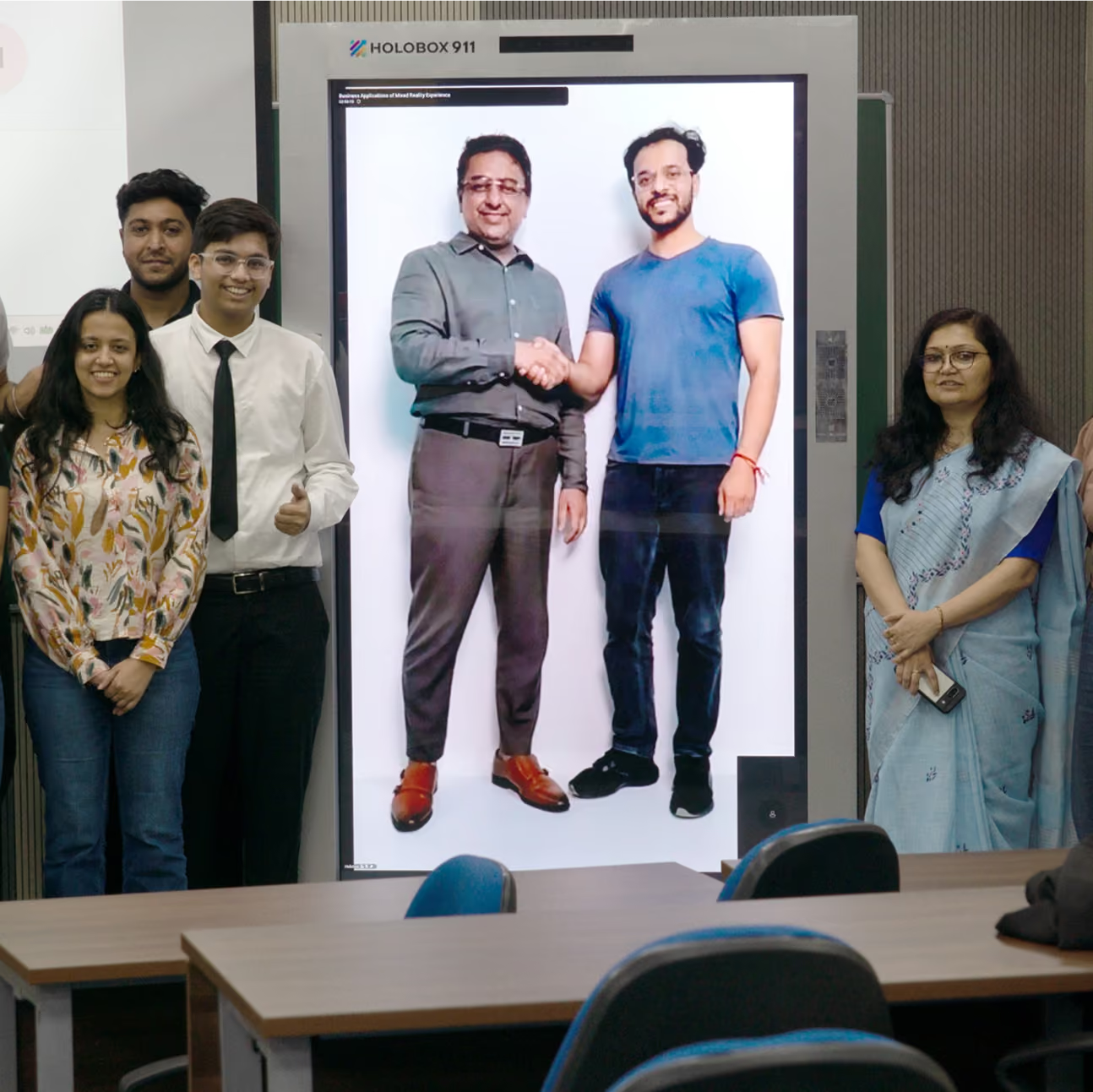
A classroom at IMT Ghaziabad during a guest session, with PGDM students and a faculty member beside a HoloBox911 display showing two remote speakers at life size

IMT Ghaziabad at a glance

InstituteInstitute of Management Technology, GhaziabadCommonly written IMT Ghaziabad or IMTG
LocationRaj Nagar, Ghaziabad 201001, Uttar PradeshPost Box No. 137, in the Delhi National Capital Region
TypePrivate autonomous management instituteSet up under the aegis of the Lajpat Rai Educational Society
Established1980The institute describes over four decades of academic legacy
ProgrammesFive two-year PGDM programmes, plus executive, doctoral and global optionsPGDM, Marketing, Financial Management, Banking & Financial Services, Dual Country
AccreditationAACSB, SAQS, NBA, AIU equivalence; AICTE approvedAlso a BGA member and a UN PRME Champion
CampusFully residentialDouble-sharing accommodation for all students; campus area is not published
Official websiteimt.eduApplications are made at admissions.imt.edu
AdmissionsCAT, XAT or GMAT, then an offline selection processOne application covers Ghaziabad, Nagpur and Hyderabad. Cycle dates change — check imt.edu

What is IMT Ghaziabad?

The Institute of Management Technology, Ghaziabad is a private, autonomous management institute in the Delhi National Capital Region. It was established in 1980 under the aegis of the Lajpat Rai Educational Society, and its flagship qualification is the two-year full-time Post Graduate Diploma in Management. The institute is approved by the All India Council for Technical Education and accredited by AACSB, and it describes itself as among the earliest Indian business schools to earn that accreditation.

In the Indian landscape, IMT Ghaziabad sits in the group of established private business schools that grew up alongside the IIMs rather than within the public system. That matters in practice: as an autonomous private institute it awards a diploma rather than a university degree, which is why the two-year PGDM carries MBA equivalence from the Association of Indian Universities, and why accreditation bodies rather than a parent university underwrite its academic standing. The same autonomy gives it room to revise curriculum and launch programmes without waiting on a university senate.

The institute states its focus as excellence and leadership development through knowledge, innovation, technological readiness, an entrepreneurial mindset and sustainability, and says its curriculum draws on industry experts, alumni and academic leaders alongside its faculty. Sustainability and social responsibility are named as institutional commitments rather than electives — the school is a United Nations PRME Champion, which is a standing commitment to responsible-management education rather than a ranking. Over four decades it has grown from a single campus into a group that also includes IMT Nagpur, IMT Hyderabad and IMT CDL, with a Dubai campus used for its dual-country programme.

What the institute is known for

Five things distinguish it from the field, all of them verifiable on the institute’s own published pages:

  • International accreditation — AACSB and SAQS, with NBA accreditation for eligible PGDM programmes
  • Specialised PGDM streams rather than a single generalist degree — marketing, financial management and banking each run as their own programme
  • A global track: the Dual Country Program with the Dubai campus, a Global Executive MBA and an MSc in Data Management
  • A fully residential campus, with double-sharing accommodation provided for all students
  • An alumni network the institute puts at more than 15,000 professionals worldwide

IMT Ghaziabad history and milestones

IMT Ghaziabad does not publish a dated timeline of its own history, so the milestones below are limited to those that can be attached to a verifiable year from the institute’s own pages and announcements. Anything undated — including the identity of the Founder Chairman, which the about page links to but does not state — has been left out rather than approximated. Read this as the documented spine of the institute’s development, not as a complete history.

MilestoneWhat is documented
1980 — foundationThe institute is established at Ghaziabad under the aegis of the Lajpat Rai Educational Society, a society registered under the Societies Registration Act of 1860. It describes the period since as over four decades of academic legacy.
2024–2026 — recognition and expansionRanked in the top 100 of the FT Masters in Management table in 2024, 30th in management in the NIRF India Rankings 2025, and in September 2026 reported re-entering the FT MiM ranking at 86th globally and placing 59th worldwide and first in India in the FT Masters in Finance ranking. Over the same period it launched a Global Executive MBA with Vlerick Business School and welcomed the PGDM Class of 2026.

IMT Ghaziabad campus and location

The campus is at Raj Nagar, Post Box No. 137, Ghaziabad 201001, in Uttar Pradesh and within the Delhi National Capital Region — close enough to Delhi and Noida for corporate visitors and recruiters to reach easily, but in its own city rather than inside the capital. The campus is fully residential, and the institute provides double-sharing accommodation to all students, with 24-hour security across the hostel zones, CCTV in common areas, controlled access, housekeeping and maintenance support, and Wi-Fi in the residential blocks. First-year male students are housed at the IMT CDL Hostel, with college-managed shuttle buses running between that hostel and the main academic campus. Dining runs through a central mess, the Arcus Canteen and a Nescafé outlet. On the academic side the institute names the Ekalavya and Aryabhatta Digital Labs for technology-enabled learning, simulations and project work, a dedicated Analytics Lab for business analytics, and a Bloomberg Finance Lab with real-time financial data and analytics tools — the last of these being the kind of facility that separates a finance specialisation on paper from one students can actually practise. The library and computer labs are open around the clock. For sport and recreation there is a basketball court, a large open ground used for cricket, football, athletics and campus events, and indoor recreation and fitness areas. One honest caveat: the institute does not publish the campus area, the number of classrooms, library holdings or hostel capacity, and third-party directories disagree on the acreage, so no figures of that kind appear on this page.

Academic programmes and courses

IMT Ghaziabad’s portfolio splits into four tiers: five two-year full-time residential PGDM programmes, an executive programme for people already in work, a doctoral route, and a set of global and short-format offerings. The structural point worth understanding before comparing it with other schools is that the specialisations are separate programmes with their own admissions, not electives chosen in the second year — an applicant to PGDM Marketing is applying to that programme, not to a general PGDM with a marketing leaning. Fees, intake sizes and durations beyond those stated on the official programme pages are not reproduced here, because they change by cycle and third-party listings disagree.

The five two-year PGDM programmes

All five are described by the institute as two-year, full-time and residential, and all are AICTE-approved with MBA equivalence from the Association of Indian Universities. They are: PGDM, the general management programme; PGDM Marketing; PGDM Financial Management; PGDM Banking & Financial Services; and the PGDM Dual Country Program, which is run across the Ghaziabad and Dubai campuses. Eligible PGDM programmes also carry National Board of Accreditation accreditation. A single application covers IMT Ghaziabad, IMT Nagpur and IMT Hyderabad, so an applicant does not have to choose a campus before applying.

Executive and doctoral routes

The PGDM Executive Programme (PGDM-ExP) is the route for candidates with work experience behind them, and it runs its own admissions cycle separate from the two-year programmes. The Fellow Program in Management (FPM) is the institute’s doctoral-track programme, also admitted separately. Third-party directories quote conflicting figures for the executive programme’s length and minimum work-experience requirement, so neither is stated here — the PGDM-ExP admissions page at imt.edu is the only reliable source for those, and it is worth checking in the cycle you intend to apply in.

Global programmes and short formats

Beyond the PGDM family the institute runs a Global Executive MBA, launched with Vlerick Business School, and an MSc in Data Management. For alumni there is a Lifelong Learning Programme. Its Management Development Programme arm offers customised programmes for organisations, open-enrolment programmes and certificate programmes — the usual route for working professionals who want a short, specific qualification rather than a full degree. The institute also runs several centres of practice that sit alongside teaching: the Centre for Financial Markets, the Innovation and Incubation Centre, the Centre for Sustainability, the Sports Research Centre and the Centre for Faculty Development.

Choosing between them

The practical question for most applicants is whether to take the general PGDM or a specialised one. The general programme keeps options open and suits anyone not yet certain which function they want; the specialised programmes commit earlier and go deeper, which is an advantage when a candidate already knows they are heading into marketing, corporate finance or banking, and a constraint if they change their mind. The Dual Country Program is a different decision again, since it involves time at the Dubai campus and is aimed at students who want an international component built into the qualification rather than added through an exchange. Anyone weighing these should read each programme page at imt.edu directly — curricula are revised between cycles, and a summary cannot substitute for the current syllabus.

Admissions and selection process

The stated eligibility requirement for the two-year PGDM programmes is a minimum three-year Bachelor’s degree in any discipline with at least 50% aggregate marks. Work experience is not mandatory, though the institute says it is weighed as part of the overall profile. Everything that follows is cycle-specific: the exam years, the deadlines and the fee all change from one admissions round to the next, and the details below reflect what IMT Ghaziabad published for the cycle current at the time of writing. Treat them as a guide to how the process is shaped, and confirm the live figures at imt.edu before you act on any of them.

Accepted entrance examinations

IMT Ghaziabad accepts CAT, XAT and GMAT scores for its two-year PGDM programmes; for the cycle published at the time of writing those were CAT 2026, XAT 2027 and GMAT. A candidate needs a valid score in one of the three, not all of them. GMAT scores carry their own deadline — the published cycle required them to reach the IMT Central Admission Office by 15 January 2027. One point frequently got wrong by third-party listings: CMAT is accepted for IMT Nagpur, not for Ghaziabad. Those same listings also disagree about which score years are valid, which is a good reason to take the exam requirement from the official admissions page and nowhere else.

The application and selection stages

The institute sets out five stages. First, apply online at admissions.imt.edu — one application covers IMT Ghaziabad, Nagpur and Hyderabad. Second, complete the profile by uploading documents through the Profile Detail Form. Third, submit test scores. Fourth, shortlisted candidates are invited to an offline common selection process. Fifth, offers are announced once evaluation is complete. The application fee for the published cycle was ₹3,500 plus applicable bank charges, and it is non-refundable once submitted. Shortlisting weighs academic performance, entrance scores, work experience where a candidate has it, professional qualifications and the overall profile — the institute does not publish a weighting formula, and the percentage splits circulated on coaching sites are unofficial estimates rather than stated policy.

What is cycle-specific, and what is not

The stable parts of the process are the eligibility threshold, the three accepted examinations, the single common application across the three campuses, and the shape of the selection process — online application, then an offline round for those shortlisted. The parts that move every year are the valid score years, the application window, the GMAT cut-off date, the fee, and the dates of the selection process and results. IMT Ghaziabad does not publish its application closing date, selection dates or result dates on the general admissions page, directing applicants to the live admissions site instead. The executive programme, the Fellow Program in Management, the MSc Data Management and the Global Executive MBA each run their own admissions, with their own criteria and calendars.

Campus life and industry engagement

Student committees and clubs

IMT Ghaziabad lists twenty-two student committees and clubs, which is a lot for a single campus and tells you something about how the place runs: much of the extracurricular and even the operational life of the institute is student-managed. They fall into four rough groups.

  • Institutional committees — Academic, Admissions, Placement, Alumni Relations, International Relations (IRC), Mess, and the Student Affairs and Welfare Council (SAWC)
  • Functional and domain clubs — Finesse, the IT and Analytics Club, the Operations Club, Markup, The Leadership Club and RACE (Research and Consulting Enterprise)
  • Enterprise and social impact — the Entrepreneurship Cell, Enactus, the Make a Difference Foundation (MADF) and the Beta Gamma Sigma honour society chapter
  • Culture, sport and wellbeing — the Cultural Committee, Sports Committee, Limelight, The EYE and the Health and Wellness Club (HAWC)

How industry reaches the campus

Industry engagement at IMT Ghaziabad is not confined to the recruitment season; the institute publishes a calendar in which corporate contact runs through the year, and two strands of it are worth separating:

  • Live projects and short-term work: the institute lists these as running throughout the year, which puts students on real company problems outside the internship window. Student publications — Markup Magazines, Finnacle Investments, FinNiche, IRC Magazines and IMTimes — give that work an outlet, and the centres of practice give it a home.
  • CXO talks, leadership sessions and guest lectures: these are a scheduled block in the institute’s own placement calendar, running from July to October, ahead of pre-placement talks. Guest lectures are therefore a structural part of the year rather than occasional extras — context worth holding on to for Section 08, which covers one such session delivered through holographic telepresence.

IMT Ghaziabad in numbers

Every figure below carries its source and, where the source states one, its reporting year. Three cautions apply. Rankings from different tables measure different programmes and are not comparable with one another. The placement figures come from IMT Ghaziabad’s own placements page, which publishes them without naming the batch they cover — so they appear here unlabelled by year rather than labelled with a guess. And figures that circulate widely on third-party education portals but do not appear on the institute’s own pages — campus acreage, student headcount, percentage of students placed — are omitted entirely.

1980
established, under the Lajpat Rai Educational Society
15,000+
alumni worldwide, on the institute’s own figure (2026)
#86
globally, FT Masters in Management Ranking 2026
#1
in India, FT Masters in Finance Ranking 2026 (#59 globally)

Published placement CTC figures

Cost to company, lakh rupees per annum. Scale 0 to 50 LPA.

Highest CTC — international₹46.17 LPA
Highest CTC — domestic₹35.00 LPA
Average CTC₹17.64 LPA
Median CTC₹16.50 LPA

Source: the headline figures published on IMT Ghaziabad’s placements page. Important caveat: that page does not state which batch these figures cover, so no year is attached to them here. The median sits well below the highest offers, which is the usual shape of a placement distribution and the reason the median is the more useful number for a prospective student. The percentage of students placed is not published.

Ranking positions, by table and year

Lower is better. Shown as published; bar length is not a measure of quality.

NIRF India, Management, 202530th
FT Masters in Finance, 202659th global, 1st India
FT Masters in Management, 202686th global
FT Masters in Management, 202497th global

Sources: IMT Ghaziabad news release, September 2026 (FT rankings) and the institute’s About page (NIRF 2025). The two FT Masters in Management entries show movement over time — 86th in 2026 against 97th in 2024, an eleven-place rise, with the institute one of 14 Indian schools in that table. Different rankings measure different programmes and are not comparable with one another.

The full figures

MeasureFigure, source and year
Year established1980, under the aegis of the Lajpat Rai Educational Society. Source: IMT Ghaziabad, About IMT.
Two-year PGDM programmes5 — PGDM, PGDM Marketing, PGDM Financial Management, PGDM Banking & Financial Services and PGDM Dual Country Program. Source: IMT Ghaziabad admissions page.
Accreditation and recognitionAACSB and SAQS accreditation; NBA accreditation for eligible PGDM programmes; AIU MBA equivalence for the two-year PGDM programmes; AICTE approval; BGA member; UN PRME Champion. Source: IMT Ghaziabad, About IMT and its September 2026 news release.
Student committees and clubs22 named bodies, plus five student magazines. Source: IMT Ghaziabad, Student Committees page.
Alumni networkMore than 15,000 professionals worldwide. Source: IMT Ghaziabad, About IMT and its September 2026 news release. This is the institute’s own figure and is not independently audited.
RankingsFT Masters in Management 2026: 86th globally, up from 97th in 2024, one of 14 Indian schools listed. FT Masters in Finance 2026: 59th globally, 1st in India. NIRF India Rankings 2025, Management: 30th. Sources: IMT Ghaziabad news release, September 2026, and its About page.
Recruiters195 recruiters, of which 86 new. Source: IMT Ghaziabad placements page. The page does not state which placement cycle these counts cover.
Placement CTCHighest ₹46.17 LPA international and ₹35.00 LPA domestic; average ₹17.64 LPA; median ₹16.50 LPA. Source: IMT Ghaziabad placements page, batch not stated. Percentage of students placed is not published.
Not published by the instituteCampus area, classroom count, library holdings, hostel capacity, student headcount, faculty headcount and the percentage of students placed. Third-party directories quote some of these but disagree with each other, so none appears on this page.

All figures above are taken from IMT Ghaziabad’s own published pages at imt.edu — About IMT, the admissions pages, the placements page, campus facilities and the student committees page — together with its September 2026 news release on the Financial Times rankings. Institute-published figures are not independently audited. Admission cycles, placement figures and ranking positions all change; confirm anything you intend to act on at imt.edu before relying on it.
HOLOBOX911 IMPLEMENTATION

HoloBox911 implementation at IMT Ghaziabad

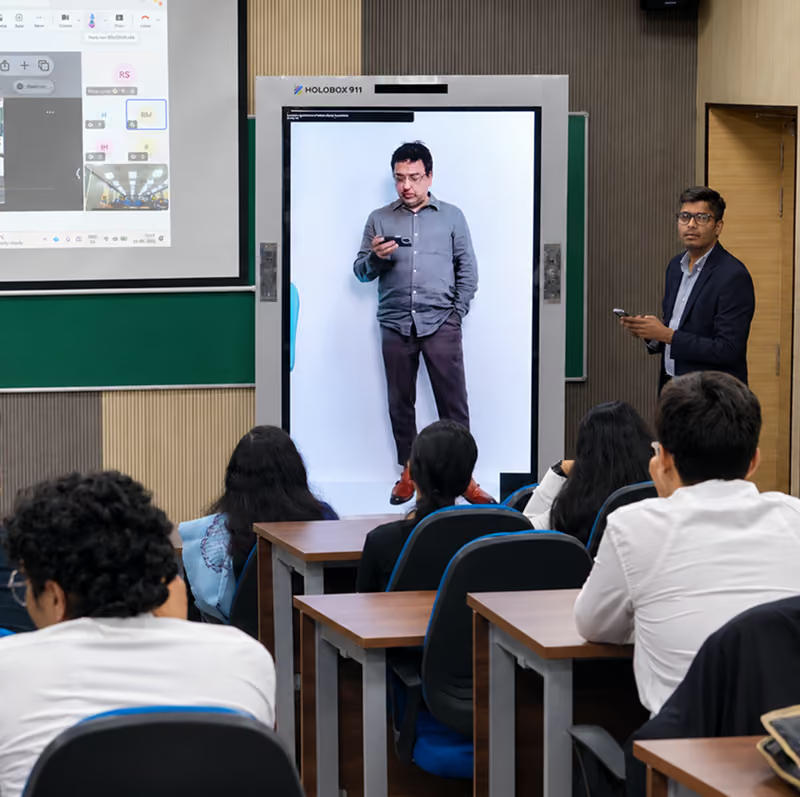
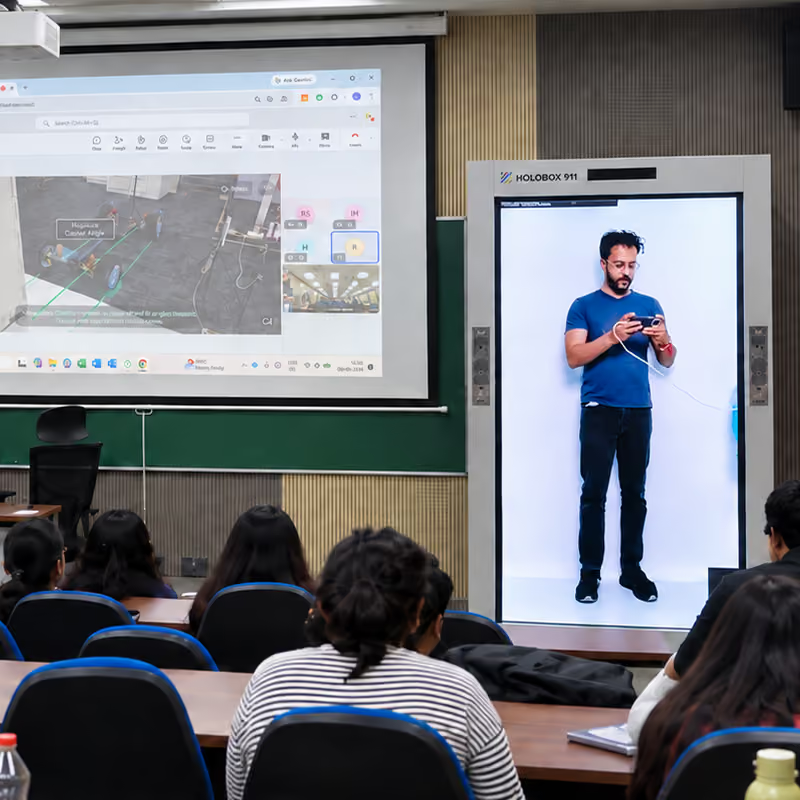
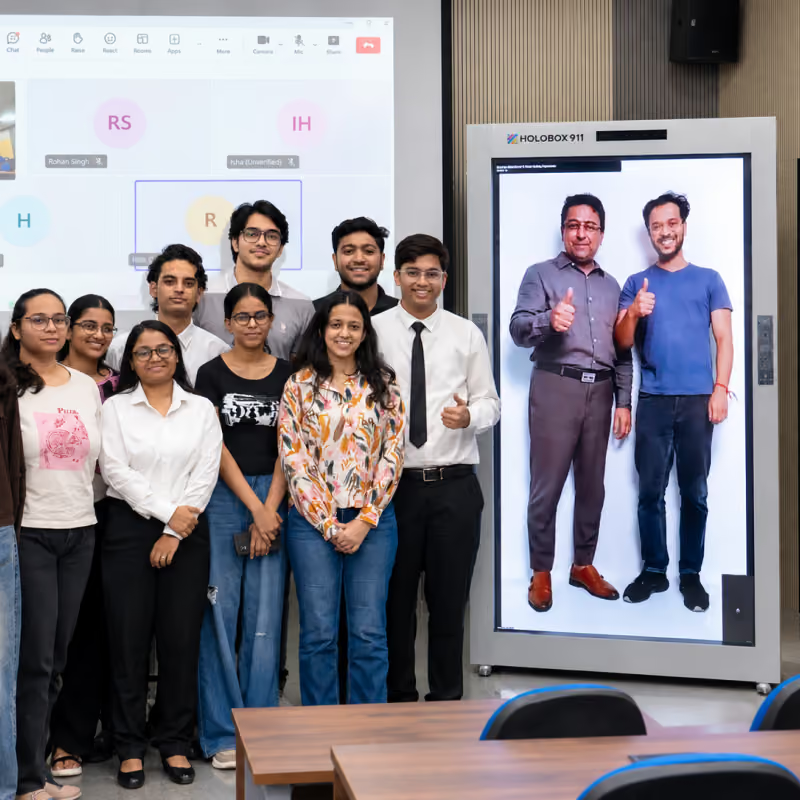
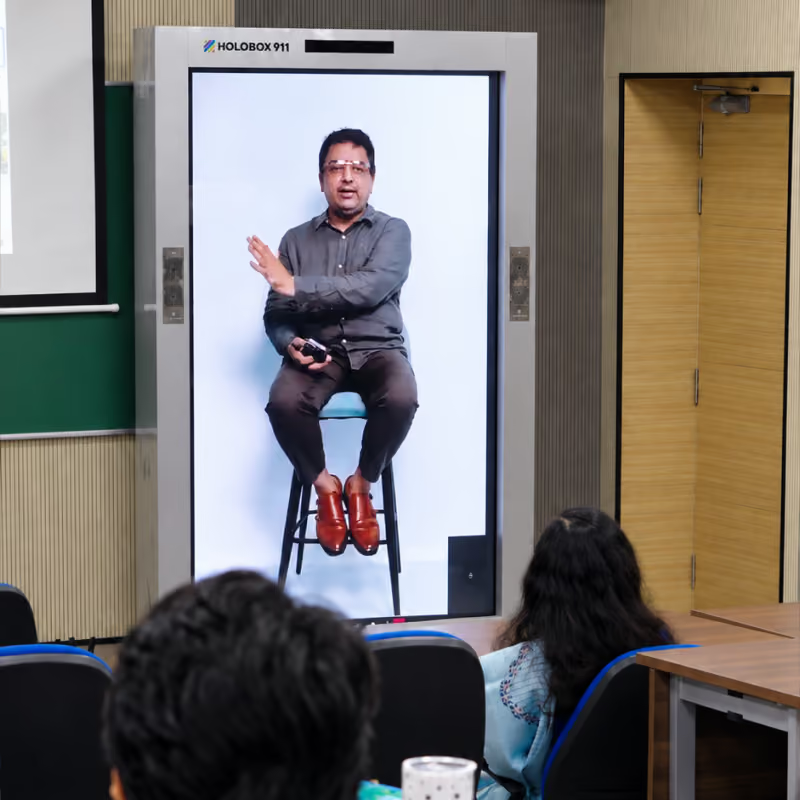
One documented example of the guest-lecture programme described above used holographic telepresence instead of a visiting speaker. A single HoloBox911 unit — an 86-inch 4K transparent display — was set up at the front of a classroom, and two guest speakers appeared inside it at full height, streamed live from a remote studio: captured against a controlled background, separated from it by chroma key, and transmitted to the unit on campus. Students in PGDM Section A could see, hear and speak with them in real time, and no headsets or 3D glasses were needed by anyone in the room. A conventional projector screen ran alongside the display for slides and 3D content. The photographs below are from that session. No date, student headcount or engagement figure has been published for it, and none is claimed. The full account is on the HoloBox911 case-study page.Explore the IMT Ghaziabad HoloBox911 Case Study

A remote guest speaker seated inside the HoloBox911 holographic display, addressing PGDM students during the guest lecture at IMT Ghaziabad
01
Both remote guest speakers appearing together at life size inside the HoloBox911 display during the holographic guest lecture at IMT Ghaziabad
02
A remote speaker presenting inside the HoloBox911 display while a participant stands beside the unit in the IMT Ghaziabad classroom, showing the life-size scale
03
The HoloBox911 holographic display and a projector screen running side by side during the IMT Ghaziabad guest lecture, with students watching from their desks
04
PGDM Section A students gathered in front of the HoloBox911 display with the two remote guest speakers after the holographic guest lecture at IMT Ghaziabad
05
1 / 5‹›

Students, alumni and career opportunities

Placement at IMT Ghaziabad is organised as a year-round process rather than a single hiring window, and the institute publishes the calendar it runs to. Live and short-term company projects run throughout the year. CXO talks, leadership sessions and guest lectures occupy the July-to-October block. Summer internship hiring falls in September, pre-placement talks in September and October, and final placement hiring in November. A student-run Placement Committee works alongside the institute’s own career services, which is consistent with how much of campus life here is student-managed. The institute describes the process as fair, transparent and high-integrity and refers to high pre-placement-offer conversion, though it does not publish a conversion rate. Its recruiter list, shown as logos on the placements page, spans consulting, banking, technology, FMCG and analytics employers.

On outcomes, it is worth being precise about what is and is not known. IMT Ghaziabad publishes headline CTC figures — a highest international offer of ₹46.17 LPA, a highest domestic offer of ₹35.00 LPA, an average of ₹17.64 LPA and a median of ₹16.50 LPA — along with 195 recruiters including 86 new ones. What it does not publish on that page is the batch those numbers describe, or the percentage of students placed, which is the single figure a prospective student should most want. The placements page does carry year-by-year report tabs, covering final placements for 2024–26, 2023–25 and 2022–24 and summer placements for 2025–27, 2024–26 and 2023–25, and those tabs are the right place to look for batch-specific detail. Beyond placement, the institute puts its alumni network at more than 15,000 professionals worldwide, supported by an Alumni Relations Committee, an alumni lifelong-learning programme and the usual sector and city chapters — the part of a business school’s value that shows up over a career rather than in a placement report.

Questions

IMT Ghaziabad: frequently asked questions

Twenty-five answers on the institute, its courses, admissions, campus, student life and placements — taken from IMT Ghaziabad’s own published pages, with gaps stated rather than filled in.

Group 1 of 4 · 7 questionsAbout the institute

What is IMT Ghaziabad?

The Institute of Management Technology, Ghaziabad is a private, autonomous management institute in the Delhi National Capital Region, established in 1980 under the aegis of the Lajpat Rai Educational Society. Its flagship qualification is the two-year full-time Post Graduate Diploma in Management. It is AICTE-approved and accredited by AACSB, and describes itself as among the earliest Indian business schools to earn AACSB accreditation.

Where is IMT Ghaziabad located?

At Raj Nagar, Post Box No. 137, Ghaziabad 201001, Uttar Pradesh — inside the Delhi National Capital Region, which puts it within reach of Delhi and Noida while sitting in its own city. The campus is fully residential.

When was IMT Ghaziabad established?

In 1980. The institute describes the period since as over four decades of academic legacy. It does not publish a dated timeline of its founding or name its Founder Chairman on the About page, so this guide states only the founding year.

What accreditations does IMT Ghaziabad hold?

AACSB and SAQS, the South Asian Quality Assurance System. Eligible PGDM programmes are accredited by the National Board of Accreditation, and the two-year PGDM programmes carry MBA equivalence from the Association of Indian Universities. The institute is AICTE-approved, a BGA member and a United Nations PRME Champion.

How is IMT Ghaziabad ranked?

Three published positions, each from a different table and year. In the Financial Times Masters in Management Ranking 2026 it is 86th globally, up from 97th in 2024, and one of 14 Indian schools listed. In the FT Masters in Finance Ranking 2026 it is 59th globally and 1st in India. In the NIRF India Rankings 2025 for management it is 30th. These measure different programmes and are not comparable with one another.

What is IMT Ghaziabad’s official website?

imt.edu is the institute’s own site, and applications are made through admissions.imt.edu. Given how widely third-party education portals disagree on fees, exam years and eligibility details, those two addresses are the only ones worth relying on for anything you intend to act on.

Does IMT have campuses other than Ghaziabad?

Yes. The IMT group also includes IMT Nagpur, IMT Hyderabad and IMT CDL, and a Dubai campus is used for the PGDM Dual Country Program. One application covers Ghaziabad, Nagpur and Hyderabad. Note that admission criteria can differ by campus — CMAT, for instance, is accepted for IMT Nagpur but not for Ghaziabad — and that statistics for one campus should not be read as applying to another.

Group 2 of 4 · 7 questionsCourses and admissions

Which courses does IMT Ghaziabad offer?

Five two-year full-time residential PGDM programmes — PGDM, PGDM Marketing, PGDM Financial Management, PGDM Banking & Financial Services, and the PGDM Dual Country Program. Alongside them run the PGDM Executive Programme, the Fellow Program in Management, a Global Executive MBA launched with Vlerick Business School, an MSc in Data Management, a lifelong learning programme for alumni, and Management Development Programmes including customised, open and certificate formats.

What is a PGDM, and how does it differ from an MBA?

A Post Graduate Diploma in Management is awarded by an autonomous institute approved by AICTE, whereas an MBA is a degree awarded by a university. In practice the distinction matters less than it sounds for employers: IMT Ghaziabad’s two-year PGDM programmes carry MBA equivalence from the Association of Indian Universities, which is what makes them count as a master’s-level qualification for further study and for public-sector eligibility. The practical advantage of the diploma route is curricular autonomy — an institute can revise its syllabus without waiting on a university process.

How does admission to IMT Ghaziabad work?

Five stages. Apply online at admissions.imt.edu — one application covers Ghaziabad, Nagpur and Hyderabad. Complete your profile by uploading documents through the Profile Detail Form. Submit your test scores. If shortlisted, attend an offline common selection process. Offers follow once evaluation is complete. Shortlisting weighs academic performance, entrance scores, work experience where you have it, professional qualifications and overall profile; the institute does not publish a weighting formula.

Which entrance exams does IMT Ghaziabad accept?

CAT, XAT or GMAT — a valid score in any one of the three, not all. For the cycle published at the time of writing those were CAT 2026, XAT 2027 and GMAT, with GMAT scores required to reach the IMT Central Admission Office by 15 January 2027. CMAT is accepted for IMT Nagpur, not for Ghaziabad. Valid score years change each cycle and third-party listings frequently get them wrong, so check the official admissions page for the round you are applying in.

What are the eligibility requirements?

For the two-year PGDM programmes, a minimum three-year Bachelor’s degree in any discipline with at least 50% aggregate marks. Any discipline qualifies — there is no requirement for a commerce or management background. Work experience is not mandatory, though it is weighed in the overall profile where a candidate has it. Eligibility can differ by programme and campus, and the executive and doctoral programmes set their own criteria.

Does IMT Ghaziabad offer executive programmes?

Yes. The PGDM Executive Programme (PGDM-ExP) is the route for candidates already in work, and it runs its own admissions cycle separate from the two-year programmes. There is also a Global Executive MBA run with Vlerick Business School, and a Management Development Programme arm offering customised, open-enrolment and certificate programmes for organisations and working professionals. Third-party sites quote conflicting durations and work-experience minimums for the executive programme, so take those from the PGDM-ExP admissions page directly.

How can prospective students contact admissions?

Through admissions.imt.edu, which carries the live application, the current cycle’s criteria and the contact details for the IMT Central Admission Office. The application fee for the published cycle was ₹3,500 plus applicable bank charges and is non-refundable once submitted. The institute does not publish its application closing date, selection dates or result dates on the general admissions page, directing applicants to the live admissions site instead — so that is where to look for deadlines rather than any summary, including this one.

Group 3 of 4 · 8 questionsCampus, student life and placements

What is the IMT Ghaziabad campus like?

Fully residential, at Raj Nagar in Ghaziabad. The institute provides double-sharing accommodation to all students, with 24-hour security across the hostel zones, CCTV in common areas, controlled access, housekeeping and maintenance support, and Wi-Fi in the residential blocks. First-year male students are housed at the IMT CDL Hostel, with college-managed shuttle buses running to the main academic campus. The institute does not publish the campus area, and third-party directories disagree on it, so no figure appears here.

What facilities are available on campus?

On the academic side: the Ekalavya and Aryabhatta Digital Labs for technology-enabled learning, simulations and project work; a dedicated Analytics Lab; and a Bloomberg Finance Lab with real-time financial data and analytics tools. The library and computer labs are open around the clock. Dining runs through a central mess, the Arcus Canteen and a Nescafé outlet. For sport there is a basketball court, a large open ground used for cricket, football, athletics and campus events, and indoor recreation and fitness areas.

What student clubs and committees does IMT Ghaziabad have?

Twenty-two named bodies. The institutional committees are Academic, Admissions, Placement, Alumni Relations, International Relations (IRC), Mess, and the Student Affairs and Welfare Council. The domain clubs include Finesse, the IT and Analytics Club, the Operations Club, Markup, The Leadership Club and RACE (Research and Consulting Enterprise). Enterprise and impact are covered by the Entrepreneurship Cell, Enactus, the Make a Difference Foundation and a Beta Gamma Sigma chapter. Culture, sport and wellbeing run through the Cultural Committee, Sports Committee, Limelight, The EYE and the Health and Wellness Club. Five student magazines also publish: Markup Magazines, Finnacle Investments, FinNiche, IRC Magazines and IMTimes.

How does IMT Ghaziabad work with industry?

Through a calendar that runs all year rather than a single hiring season. Live and short-term company projects run throughout the year; CXO talks, leadership sessions and guest lectures occupy July to October; summer internship hiring falls in September; pre-placement talks in September and October; and final placement hiring in November. The institute also says its curriculum draws on industry experts and alumni alongside faculty, and it runs centres of practice — including the Centre for Financial Markets and the Innovation and Incubation Centre — that give that engagement somewhere to live outside the timetable.

Does IMT Ghaziabad organise guest lectures?

Yes, and they are a scheduled part of the year rather than occasional extras — the institute’s own placement calendar sets aside July to October for CXO talks, leadership sessions and guest lectures, ahead of pre-placement talks. One documented session used holographic telepresence to bring two remote speakers into a classroom at life size; that is covered in Section 08 of this guide.

How are placements conducted at IMT Ghaziabad?

As a year-round process. Summer internship hiring runs in September, pre-placement talks in September and October, and final placement hiring in November, with live projects and corporate sessions through the rest of the year. A student-run Placement Committee works alongside the institute’s career services. The institute describes the process as fair, transparent and high-integrity and refers to high pre-placement-offer conversion, though it does not publish a conversion rate.

Where can official placement reports be found?

On the placements page at imt.edu, which carries year-by-year report tabs — final placements for 2024–26, 2023–25 and 2022–24, and summer placements for 2025–27, 2024–26 and 2023–25. That is the right place to look for batch-specific detail. The headline figures shown above those tabs — a highest international offer of ₹46.17 LPA, a highest domestic offer of ₹35.00 LPA, an average of ₹17.64 LPA, a median of ₹16.50 LPA, and 195 recruiters including 86 new ones — are published without naming the batch they cover, and the percentage of students placed is not published at all. Treat any placement percentage you see on a third-party site with caution unless it cites one of those reports.

What is the IMT Ghaziabad alumni network?

The institute puts it at more than 15,000 professionals worldwide, across sectors. It is supported by a student-run Alumni Relations Committee and a Lifelong Learning Programme that keeps alumni connected to the institute’s teaching after they graduate. This is the institute’s own figure and is not independently audited — but the network is the part of a business school’s value that shows up over a career rather than in any single placement report.

Group 4 of 4 · 3 questionsHoloBox911 at IMT Ghaziabad

What was the HoloBox911 classroom experience at IMT Ghaziabad?

A guest lecture in which the two speakers appeared through holographic telepresence rather than in person. A single HoloBox911 unit — an 86-inch 4K transparent display — stood at the front of the classroom, and the speakers were streamed live from a remote studio at full human height. Students in PGDM Section A could see, hear and speak with them in real time, with no headsets or 3D glasses required. No date, student headcount or engagement figure has been published for the session.

What does immersive technology add to a management classroom?

Mainly, it changes who can realistically be in the room. A senior practitioner can usually spare an hour but not the half-day of travel either side of it, and that arithmetic quietly removes most would-be guest speakers from a calendar. Remove the travel and geography stops being the filter. Presenting a speaker at human height rather than in a rectangle on a wall also changes how a class behaves towards them. It does not make the speaker physically present, and it does not replace the informal contact around a real campus visit.

Where can I read the HoloBox911 IMT Ghaziabad case study?

At holobox911.com/imt-holobox911, also linked from Section 08 of this guide. That page is the record of the deployment itself; this page is a guide to IMT Ghaziabad as an institute, and the two are kept separate on purpose.

We are here to help you! Contact us at +91 95601 32502 or email at sales@holobox911.com
IconPhoneChat on WhatsApp
Close

Bring Your Brand to Life with HoloBox911

Experience life-size, glasses-free 3D holographic experiences for events, exhibitions, retail, and business.
MecversityCTC
Life-Size 3D Holographic Display
Perfect for Events & Exhibitions
AI Avatar & Telepresence

Download the Brochure

Tell us about your requirement and our team will get in touch with you.
Download
Thank you for submitting your Details. Click on the link below to Download the Brochure
Download
Oops! Something went wrong while submitting the form.