India's 1st
CE-Certified
Hologram
CERTIFIED
Automotive event · Maruti Suzuki · Dealer convention

Maruti Suzuki MQFC 2.0: Dealer Convention and Event Guide

MQFC 2.0 was an internal Maruti Suzuki convention for the company's dealer network, held in March 2025 according to HoloBox911's own records. A life-size AI avatar took unscripted questions from the floor in English and Japanese, on automobile technology, sustainability practices and market quality standards. This guide covers the convention, its organiser, the automotive market-quality context it sits in, who took part, and the holographic implementation that ran on the day. Where a detail is not on the public record — the venue among them — this page says so rather than filling the gap.

Compiled by the HoloBox911 team from Maruti Suzuki's own published figures and HoloBox911's production records · Images on this page are HoloBox911 illustrations of the deployment, not documentary event photographs · Updated 9 October 2026
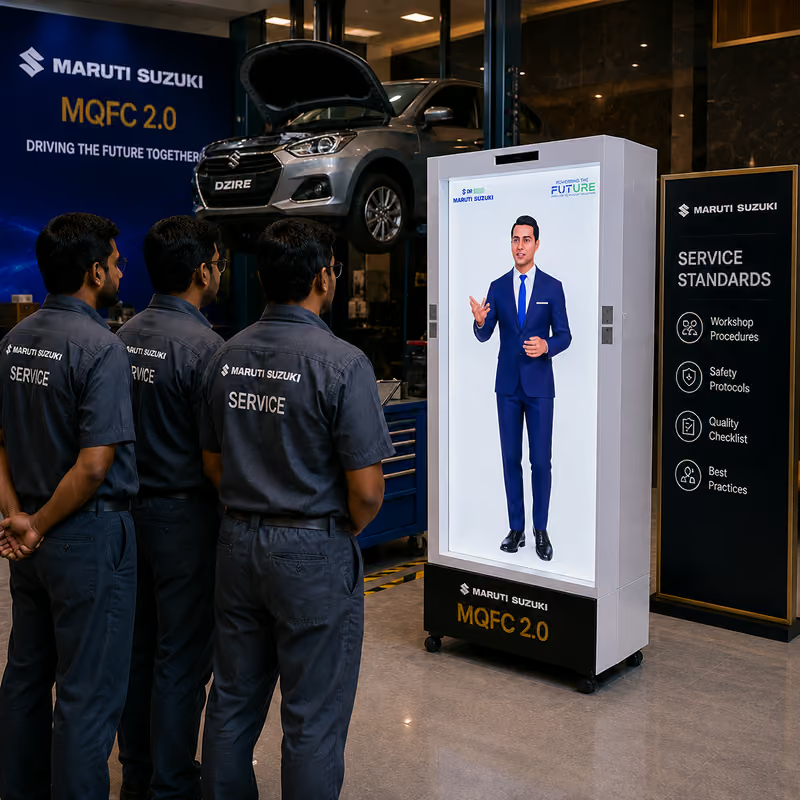
HoloBox911 illustration, not a documentary photograph: a HoloBox911 unit beside a Maruti Suzuki MQFC 2.0 backdrop and a service-standards panel, with service staff and a vehicle on a workshop lift

MQFC 2.0 at a glance

EventMQFC 2.0Referred to throughout as MQFC 2.0. No expansion of the initialism appears on the public record.
OrganiserMaruti Suzuki India LimitedA subsidiary of Suzuki Motor Corporation, Japan, and India's largest passenger car maker.
Event typeInternal dealer conventionAn invited company event for the dealer network. Not a public show: no registration, no ticketing, no exhibition floor.
VenueNot confirmedReported as Andaz Delhi, Aerocity, New Delhi, but no documentary evidence has been found. Treated as unverified pending confirmation.
DateMarch 2025 (company-reported)The month appears on HoloBox911's own company page. It is not corroborated by Maruti Suzuki or by trade coverage, and no exact day is published.
Event focusMarket quality and the dealer networkQuestions on the day covered automobile technology, sustainability practices and market quality standards.
Audience~600 on the main stageProvider-reported: 600 representatives at the stage session, 120+ representatives and dealership staff in the engagement zone.
Implementation recordHoloBox911 at MQFC 2.0The existing client case study for the bilingual AI avatar deployment.
Official event websiteNone publishedAs an internal convention, MQFC 2.0 has no public event site, registration page or delegate listing.

What is Maruti Suzuki MQFC 2.0?

MQFC 2.0 was an internal convention held by Maruti Suzuki India Limited for its dealer network. It was a company event rather than a public show: invited representatives from across the network, a main-stage session, and a separate engagement area where people could carry on the conversation one to one. The "2.0" marks it as a second edition.

A note on the name, because it matters for anyone researching the event. MQFC is used as an initialism by every available source, and none of them expands it. Searches of Maruti Suzuki's own websites, press releases and reports return no expansion, and no trade coverage uses one either. What the sources do agree on is the character of the event: HoloBox911's records label it a dealer convention and a franchise convention stage, and Metaverse911's project record calls it an internal event. This page therefore describes MQFC 2.0 as a dealer convention and does not assert a full name it cannot evidence.

What is documented is the subject matter. Questions taken on the day covered automobile technology, sustainability practices and market quality standards. That last phrase places the convention squarely in the territory of market quality, which is why the themes below are worth setting out properly — they are the working vocabulary of the people who were in the room.

Market quality, and why a carmaker convenes its dealers about it

Market quality is the industry's term for how a vehicle behaves once it has left the factory and is in customers' hands — as distinct from the quality checks performed on the production line. It is measured through what comes back from the field, and the dealer network is where almost all of that information is generated. The points below are standard industry practice rather than claims about this particular agenda.

  • Field feedback: workshops and service advisers see failures, complaints and wear patterns long before they show up in aggregate data.
  • Warranty intelligence: warranty claims carry a part number, a symptom and a date, which makes them one of the few structured signals a manufacturer gets from real use.
  • Consistency across the network: the same fault should be diagnosed, recorded and escalated the same way in every workshop, or the data is noise.
  • Speed of the loop: the value of a field signal decays. A pattern caught in weeks can be engineered out; one caught in years has already shipped.
  • Customer experience: for the owner, quality and service are the same thing. A fault handled well can leave a better impression than no fault at all.

MQFC 2.0 dates, schedule and programme

MQFC 2.0 took place in March 2025 according to HoloBox911's own company page, which is the only source that gives a date; Maruti Suzuki has published none, and no trade coverage corroborates it. The venue is reported as Andaz Delhi but is not confirmed, and is treated as unverified on this page. Beyond the month, nothing about the running order is on the public record, and this page does not fill the gap. What can be stated is the shape of the day, because two distinct formats are documented. The table below carries only what is attested; a session-by-session agenda is deliberately absent.

Element of the programmeWhat is documented
Main-stage sessionA live, unscripted question-and-answer session in front of the assembled representatives, run in English and Japanese. Start time, duration and running order are not published.
Engagement zoneAfter the stage session the installation moved to a separate engagement area for one-to-one questions from representatives and dealership staff. No timings are published. No speaker list, leadership address, award or networking schedule has been published for MQFC 2.0, so none appears on this page.

Where MQFC 2.0 was held

The venue for MQFC 2.0 is not confirmed. HoloBox911's records and a participant account place it at Andaz Delhi, a Hyatt-brand hotel at Asset No. 1, Aerocity, New Delhi 110037, a few minutes from Indira Gandhi International Airport. That would be a plausible fit: Aerocity's airport proximity suits a one-day national dealer convention that draws people in from across India, and the property has a ballroom as its principal function space alongside smaller meeting rooms, which matches the two-format shape of this particular day. But no documentary evidence confirms the venue, so this page marks it unverified pending confirmation rather than stating it as fact. No room name or floor plan has been published for MQFC 2.0, and published capacity figures for the property itself disagree between directories, so none is quoted. One thing worth stating plainly for anyone comparing Maruti Suzuki events: MQFC 2.0 is not the Maruti Suzuki Vendor Conference, which is a separate event for the supplier base, held at a different venue on different dates. Details from one should never be carried across to the other.

About Maruti Suzuki India Limited

Maruti Suzuki India Limited, formerly Maruti Udyog Limited, was set up in February 1981 as a joint venture between the Government of India and Suzuki Motor Corporation of Japan. It is now a subsidiary of Suzuki Motor Corporation and is listed on the NSE and BSE. Every figure below carries its reporting period, because the company's network and sales numbers move quickly and a figure from one year is not comparable with another.

Scale, in the year the convention was held

MQFC 2.0 is reported to have taken place in March 2025, which falls at the close of financial year 2024-25. In that year Maruti Suzuki reported its highest-ever annual domestic sales of 1,795,259 units and highest-ever annual exports of 332,585 units — together around 2.13 million vehicles, and the second consecutive year above the two-million mark. Those are the company's figures for the period in which the convention is reported to have fallen.

The retail network the convention was convened for

Maruti Suzuki sells through multiple retail channels — ARENA, NEXA and a commercial channel. The company reported 3,925 sales outlets across 2,577 towns and cities in August 2024, with ARENA alone at 3,069 outlets across 2,596 cities a month later. By February 2026 NEXA had passed 740 outlets across more than 530 cities. Each of those is a dated snapshot, not a running total, and they should not be added together.

Aftersales: where market quality is actually observed

The service network is the part of the business most directly tied to the subject of this convention. Maruti Suzuki opened 460 service touchpoints under the ARENA and NEXA channels in FY 2024-25, then a record 502 in FY 2025-26, taking the after-sales network to 5,926 touchpoints across 3,000 cities and towns as reported in April 2026. The company passed its 6,000th touchpoint in July 2026 and has stated a target of around 8,000 by FY 2030-31. In FY 2025-26 it serviced over 2.84 crore vehicles, the most it has handled in a single financial year.

Direction of travel, and sustainability

Maruti Suzuki's Annual Integrated Report 2025-26, themed "The Next Million, New Momentum", reported the company's highest-ever annual sales of 24.22 lakh vehicles and record exports of 4.47 lakh, a third consecutive year above two million. The company has said it plans to introduce seven SUVs over five years, and its board has approved four biogas plants in a first phase at a cost of Rs 561 crore. These figures postdate MQFC 2.0 and are given as organiser context, not as event outcomes.

Event theme and automotive quality focus

Three subjects are documented as having come up at MQFC 2.0: automobile technology, sustainability practices and market quality standards. Those three are what the questions on the day were about, and they are the only agenda claims this page makes. Everything that follows under the three headings below is industry context explaining why each subject belongs at a dealer convention — it is not a record of what was said, and no official event slogan or theme line has been published. Where a topic below was not among the three documented subjects, it is marked as broader context.

Market quality standards (documented subject)

A market quality standard is the agreed definition of what counts as a defect, how it is recorded and how quickly it must be escalated. Its value depends entirely on being applied identically everywhere. That is a training and communication problem before it is an engineering one, which is why it is worth gathering a dealer network in one room to go through it rather than circulating a document.

Automobile technology (documented subject)

Powertrains, electronics and driver-assistance systems change what a workshop needs to know faster than any manual can be reissued. A dealer-facing session on technology is largely about closing that gap: making sure the people who meet the customer can explain what is in the vehicle and diagnose it correctly when it comes back.

Field feedback, warranty intelligence and AI-assisted workflows (broader context)

These were not named among the documented subjects of MQFC 2.0, and are included only because they are the standard apparatus around market quality. Field feedback is the raw stream from workshops; warranty intelligence is the structured subset of it that carries part numbers and dates; AI-assisted workflows are a current industry approach to triaging that volume, by clustering free-text complaints or surfacing the right procedure on the workshop floor. Any claim that MQFC 2.0 covered these specifically would need a source, and none exists.

Event highlights and technology demonstrations

The main-stage session

The documented highlight of MQFC 2.0 was a live, unscripted question-and-answer session on the main stage, taken by a life-size interactive display in front of the assembled representatives. Four things about it are on the record.

  • The questions were unscripted and came from the floor, not from a prepared running order.
  • Two languages were live in the room: representatives asked in English and in Japanese.
  • Subject matter covered automobile technology, sustainability practices and market quality standards.
  • Answers were drawn only from material Maruti Suzuki had approved, rather than from open-web sources.

The engagement zone, and what is not documented

After the plenary, the installation moved to a separate engagement area where representatives and dealership staff could ask their own questions one to one. Running a plenary format and a booth format on the same day, from the same unit, is the structural point of interest: they are opposite jobs, and a single day rarely has room for two builds. Two cautions belong here.

  • Not the Vendor Conference: Maruti Suzuki's Vendor Conference is a separate event for the supplier base, with its own venue, dates and deployment. Its DigiLib project corpus, its on-premise AI build and its supplier film belong to that event and are not part of MQFC 2.0.
  • No other demonstrations are documented: no exhibition, no awards, no product reveal and no additional technology stand has been published for MQFC 2.0. The absence of a record is not evidence that nothing else happened, but nothing else is claimed here.

MQFC 2.0 and the automotive industry in numbers

Two kinds of number appear below and they must not be read together. The event figures are provider-reported deployment counts from the companies that ran the installation; Maruti Suzuki has published no attendance figure of its own for MQFC 2.0. The corporate figures come from Maruti Suzuki's own releases, each with its reporting period attached. A corporate figure is never an achievement of a single convention.

600
Representatives at the MQFC 2.0 main-stage session. Provider-reported, not an organiser figure.
120+
Representatives and dealership staff who engaged in the engagement zone. A count of people, not of interactions.
2
Languages live in the room on the day — English and Japanese.
March 2025
Company-reported date, from HoloBox911's own records. Not corroborated, and the venue is unverified.

These four are the only MQFC 2.0 event figures available, and none of them is published by Maruti Suzuki: two are provider-reported deployment counts rather than attendance totals, and the date comes from a single company source. Maruti Suzuki's corporate statistics are kept in the table below rather than tiled alongside these, deliberately: an audience count and a national sales figure measure different things, and no chart is drawn across them.

Every figure, with its source, scope and period

FigureValue, source, scope and period
Main-stage audience (event)600 representatives. Provider-reported by Metaverse911 as a deployment figure, not an organiser-published attendance total, and not independently corroborated.
Engagement zone (event)120+ representatives and dealership staff engaged. Provider-reported. Note this is a count of people, not of interactions.
Languages live in the room (event)Two — English and Japanese. Stated by both the HoloBox911 case study and Metaverse911's project record.
Domestic sales (corporate)1,795,259 units in FY 2024-25, the company's highest ever. Maruti Suzuki India Limited, full financial year.
Exports (corporate)332,585 units in FY 2024-25, the company's highest ever. Rose to a record 4.47 lakh units in FY 2025-26.
Total annual sales (corporate)Around 2.13 million units in FY 2024-25 (domestic plus exports), a second consecutive year above two million. 24.22 lakh in FY 2025-26, the highest ever and a third consecutive year above two million.
Service network (corporate)460 touchpoints opened in FY 2024-25; a record 502 added in FY 2025-26, taking the after-sales network to 5,926 touchpoints across 3,000 cities and towns as reported in April 2026. 6,000th touchpoint reached July 2026.
Sales network (corporate)3,925 sales outlets across 2,577 towns and cities, as reported August 2024 (ARENA, NEXA and Commercial combined). ARENA alone 3,069 outlets across 2,596 cities, September 2024. NEXA over 740 outlets across 530+ cities, February 2026. Dated snapshots — do not add together.
Vehicles serviced (corporate)Over 2.84 crore vehicles serviced in FY 2025-26, the most in a single financial year. Target of around 8,000 service touchpoints by FY 2030-31.

Corporate figures are as published by Maruti Suzuki India Limited and read in October 2026; the Indian financial year runs April to March, so FY 2024-25 is the year in which MQFC 2.0 was held and FY 2025-26 figures postdate it. Event figures are provider-reported by the companies that delivered the installation and have not been confirmed by Maruti Suzuki. No chart is drawn across the two groups: an attendance count and a national sales total are not comparable measurements, and plotting them together would imply a relationship that does not exist.
HoloBox911 implementation

HoloBox911 implementation at MQFC 2.0

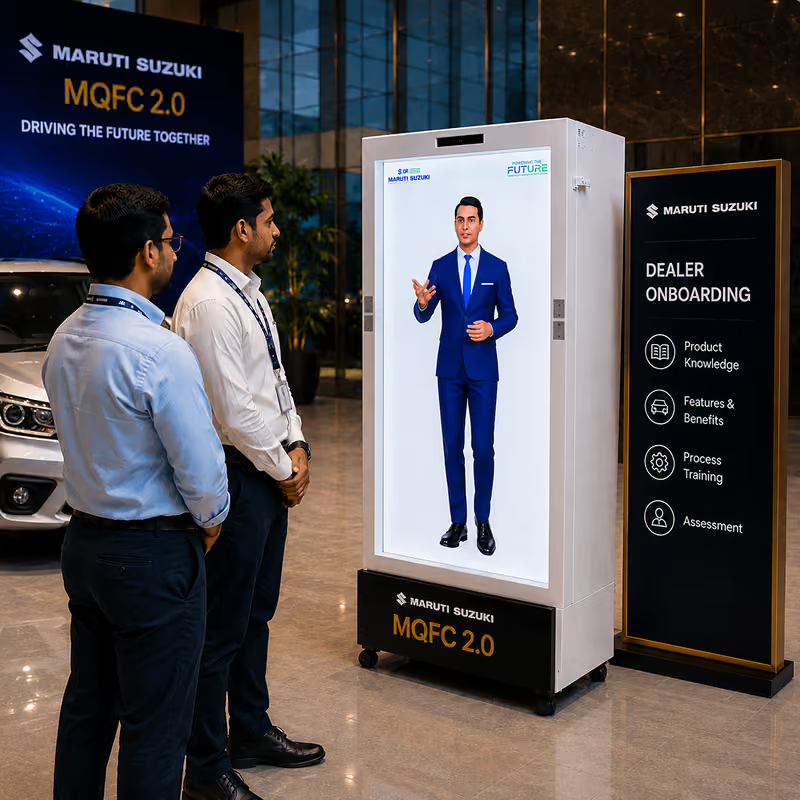
This is the only section of this page about HoloBox911. Maruti Suzuki hired a HoloBox911 unit and crew for MQFC 2.0. A life-size digital presenter inside an 86-inch 4K transparent enclosure took live, unscripted questions from representatives on the main stage — in English and Japanese — then moved to the engagement zone for one-to-one questions, with a 22-inch touch overlay carrying supporting detail. A far-field microphone array picked questions out of convention-hall noise, and answers were drawn only from material Maruti Suzuki had approved, covering automobile technology, sustainability practices and market quality standards; where the knowledge base had a gap, the unit said so rather than inventing an answer. Nobody wore a headset or 3D glasses. Please note that the two images below, and the image in the page header, are HoloBox911 illustrations of this deployment — they are computer-generated renders carrying MQFC 2.0 branding, not documentary photographs taken at the convention. No verified photograph of MQFC 2.0 is available, and nothing from the separate Maruti Suzuki Vendor Conference has been used in its place. The full implementation record is in the client case study. Explore the Maruti Suzuki MQFC 2.0 HoloBox911 Case Study →

HoloBox911 illustration, not a documentary photograph: a HoloBox911 unit showing a life-size digital presenter beside a Maruti Suzuki MQFC 2.0 backdrop and a dealer-onboarding panel, with two dealership staff looking on
01
HoloBox911 illustration, not a documentary photograph: a HoloBox911 unit beside a Maruti Suzuki MQFC 2.0 backdrop and a service-standards panel listing workshop procedures, safety protocols, quality checklist and best practices
02
1 / 2‹›

Who attended MQFC 2.0

The documented audience was Maruti Suzuki's own dealer network. Around 600 representatives were present for the main-stage session, and 120 or more representatives and dealership staff engaged in the engagement area afterwards — both figures reported by the companies that delivered the installation rather than published by Maruti Suzuki, and neither independently corroborated. Questions came in English and Japanese, which indicates a mixed Indian and Japanese presence in the room, consistent with Maruti Suzuki's ownership by Suzuki Motor Corporation. No delegate list, no breakdown by region or function, and no organiser attendance total has been published, so none is given here.

Beyond the people actually in the room, it is worth naming the wider groups a market-quality convention speaks to, clearly marked as context rather than as a participant list: dealer principals and sales management, service managers and workshop technicians, aftersales and customer-care teams, quality and warranty analysts at the manufacturer, and the training function that has to turn any of it into standard practice across thousands of outlets. Whether each of those was represented at MQFC 2.0 is not documented. What is documented is that the event was internal to Maruti Suzuki and its dealers: there was no public registration, no ticketing and no exhibition floor.

Frequently asked questions

Maruti Suzuki MQFC 2.0: 25 questions

Twenty-five questions on the convention, on market quality in the motor industry, on Maruti Suzuki as organiser, and on the holographic implementation. Where no verified answer exists, the answer says so.

Questions 1–7The MQFC 2.0 convention

What is MQFC 2.0?

MQFC 2.0 was an internal convention held by Maruti Suzuki India Limited for its dealer network, reported to have taken place in March 2025. It combined a main-stage session in front of the assembled representatives with a separate engagement area for one-to-one conversation. The "2.0" marks it as a second edition.

What does MQFC stand for?

No expansion of the initialism is on the public record. Every available source uses "MQFC" without spelling it out, and searches of Maruti Suzuki's own websites, press releases and reports return nothing. Rather than guess, this page describes the event by what its sources do establish: a dealer convention concerned with market quality. If you have seen an expansion elsewhere, treat it as unverified until Maruti Suzuki publishes one.

Who organised MQFC 2.0?

Maruti Suzuki India Limited, for its own dealer network. It was a company event, so the organiser and the beneficiary were the same party — unlike a trade show, where a third-party organiser sells floor space and sets the agenda.

Where was MQFC 2.0 held?

The venue is not confirmed. HoloBox911's records and a participant account report it as Andaz Delhi, a Hyatt-brand hotel at Asset No. 1, Aerocity, New Delhi 110037, but no documentary evidence has been found to confirm that, so this page treats the venue as unverified. No room name or floor plan has been published for the event either.

When did MQFC 2.0 take place?

March 2025, according to HoloBox911's own company page — the only source that gives a date. Maruti Suzuki has published none and no trade coverage corroborates it, so treat the month as company-reported rather than confirmed. No exact day, running order or session timing is published.

Was MQFC 2.0 a public event, and was an agenda published?

No on both counts. It was an invited internal convention for Maruti Suzuki's dealer network: no public registration, no ticketing, no exhibition floor and no official event website. No agenda, speaker list or programme has been published.

Is MQFC 2.0 different from the Maruti Suzuki Vendor Conference?

Yes, entirely. They are separate events with different audiences, venues and dates: MQFC 2.0 is for the dealer network, while the Vendor Conference is for Maruti Suzuki's supplier base. Figures and features from the Vendor Conference — its DigiLib project corpus, its on-premise AI build, its supplier film and its venue — belong to that event alone and should never be attributed to MQFC 2.0.

Questions 8–14Market quality and the field

What is market quality in the automotive industry?

Market quality describes how a vehicle performs once it is in customers' hands, as distinct from the quality checks carried out on the production line. A car can pass every factory gate and still generate complaints in the field — from wear in conditions the test cycle did not cover, from a component that fails only after a certain mileage, or from a fault that is handled badly at the workshop. Market quality is the discipline of measuring and closing that gap.

Why is field feedback important?

Because the field is where failures actually appear. A workshop sees a pattern — the same part, the same symptom, the same vehicle age — months before it is visible in aggregate data at head office. The value of that signal decays quickly: a pattern caught in weeks can be engineered out of the next build, while one caught years later has already shipped to hundreds of thousands of owners.

How does automotive quality management work?

In outline: a standard defines what counts as a defect and how it is recorded; workshops log what they see against that standard; the records are aggregated and analysed for patterns; engineering investigates the patterns that matter; and a countermeasure goes into production, service procedure or training. The weak link is almost always consistency — if two workshops record the same fault differently, the aggregate is noise. This is general industry practice, not a description of Maruti Suzuki's internal process.

What is warranty intelligence?

Warranty intelligence is the practice of treating warranty claims as a data source rather than only as a cost. Each claim carries a part number, a symptom code, a date and a vehicle identity, which makes it one of the few structured signals a manufacturer receives from real-world use. Analysed in volume, claims reveal which components are failing, where, and at what age.

How can AI support field quality work?

Mostly by handling volume and inconsistency. Free-text complaint notes can be clustered so that five phrasings of one fault are recognised as the same issue; claim streams can be monitored for emerging patterns; and the correct procedure can be surfaced to a technician on the workshop floor instead of being hunted through a manual. This is industry context. It is not a claim about what was demonstrated at MQFC 2.0.

What is the connection between field quality and customer satisfaction?

For the owner they are indistinguishable. Nobody experiences "a quality process"; they experience whether the fault was diagnosed correctly, fixed first time, and explained honestly. A fault handled well can leave a better impression than no fault at all, which is why market quality work tends to be aimed at the service network rather than only at the factory.

What was the official theme or slogan of MQFC 2.0?

No official theme line or slogan has been published for MQFC 2.0, so none is quoted here. What is documented is the subject matter of the questions taken on the day: automobile technology, sustainability practices and market quality standards.

Questions 15–22Maruti Suzuki and its dealer network

What is Maruti Suzuki India Limited?

Maruti Suzuki India Limited, formerly Maruti Udyog Limited, was set up in February 1981 as a joint venture between the Government of India and Suzuki Motor Corporation of Japan. It is now a subsidiary of Suzuki Motor Corporation, is listed on the NSE and BSE, and is India's largest passenger car maker.

How many vehicles does Maruti Suzuki sell?

In FY 2024-25, the year MQFC 2.0 was held, the company reported highest-ever domestic sales of 1,795,259 units and highest-ever exports of 332,585 units, around 2.13 million in total and a second consecutive year above two million. In FY 2025-26 it reported its highest-ever annual sales of 24.22 lakh vehicles and record exports of 4.47 lakh, a third consecutive year above two million.

How large is Maruti Suzuki's service network?

The company opened 460 service touchpoints in FY 2024-25 and a record 502 in FY 2025-26, taking its after-sales network to 5,926 touchpoints across 3,000 cities and towns as reported in April 2026. It passed its 6,000th touchpoint in July 2026 and has set a target of around 8,000 by FY 2030-31. In FY 2025-26 it serviced over 2.84 crore vehicles, the most in a single financial year.

What role do dealerships play for a carmaker?

They are the manufacturer's only sustained contact with the customer. They sell the vehicle, service it for its working life, and — for quality purposes — generate nearly all the information the manufacturer receives about how its products behave in the real world. That dual role is why a convention aimed at market quality is held for the dealer network rather than inside the factory.

How big is Maruti Suzuki's sales network?

The company reported 3,925 sales outlets across 2,577 towns and cities in August 2024, covering its ARENA, NEXA and commercial channels. ARENA alone stood at 3,069 outlets across 2,596 cities in September 2024, and NEXA had passed 740 outlets across more than 530 cities by February 2026. These are separate dated snapshots of overlapping channels and should not be added together.

How does Maruti Suzuki approach customer service?

The clearest public evidence is the shape of the network itself. Maruti Suzuki reports its after-sales reach in touchpoints rather than workshops alone, and the formats it names — ARENA and NEXA workshops, Maruti Suzuki Sales and Service Points, Service-on-Wheels and Bodyshop-on-wheels — indicate a strategy of reaching customers close to where they are, including smaller towns, rather than concentrating capacity in large centres. Its stated target of around 8,000 touchpoints by FY 2030-31 continues that direction.

Who participated in MQFC 2.0?

Maruti Suzuki's dealer network. Around 600 representatives attended the main-stage session and 120 or more representatives and dealership staff engaged in the engagement area afterwards. Both figures are reported by the companies that delivered the installation, not published by Maruti Suzuki, and neither is independently corroborated. Questions came in English and Japanese. No delegate list or breakdown by role or region has been published.

What digital technologies were demonstrated at MQFC 2.0?

One is documented: the life-size interactive holographic display that took live bilingual questions on the main stage and then in the engagement zone. No other exhibition, product reveal, awards presentation or technology stand has been published for MQFC 2.0. That does not prove nothing else took place, but nothing else is claimed on this page.

Questions 23–25The HoloBox911 implementation

How was HoloBox911 used at MQFC 2.0, and was bilingual interaction demonstrated?

Maruti Suzuki hired a HoloBox911 unit and crew. A life-size digital presenter inside an 86-inch 4K transparent enclosure took live, unscripted questions from representatives on the main stage, then moved to the engagement zone for one-to-one questions, with a 22-inch touch overlay alongside for supporting detail. Yes, bilingual interaction is documented: questions were asked and answered in both English and Japanese. Answers were drawn only from material Maruti Suzuki had approved, covering automobile technology, sustainability practices and market quality standards, and where the knowledge base had a gap the unit said so rather than inventing an answer. No headsets or 3D glasses were needed.

Where can I see implementation photographs, and where is the full case study?

The full implementation record is in the HoloBox911 client case study for MQFC 2.0, linked from Section 08 above. On images: the two shown in Section 08 and the one in the page header are HoloBox911 illustrations — computer-generated renders carrying MQFC 2.0 branding — and are labelled as such rather than presented as documentary event photography. No verified photograph of MQFC 2.0 exists in the asset library. The genuine-looking Maruti Suzuki photographs in circulation carry DigiLib Avatar branding, which belongs to the separate Vendor Conference, so none of them has been used here.

Was the MQFC 2.0 deployment the same as the one at the Vendor Conference?

No. The same hardware platform was used, but they were different builds for different audiences. MQFC 2.0 was a bilingual live question-and-answer deployment for the dealer network, on a main stage and then in an engagement zone. The Vendor Conference deployment was a separate project for the supplier base, with its own corpus, its own venue and its own dates. Any figure quoted for one should not be read across to the other.

We are here to help you! Contact us at +91 95601 32502 or email at sales@holobox911.com
IconPhoneChat on WhatsApp
Close

Bring Your Brand to Life with HoloBox911

Experience life-size, glasses-free 3D holographic experiences for events, exhibitions, retail, and business.
MecversityCTC
Life-Size 3D Holographic Display
Perfect for Events & Exhibitions
AI Avatar & Telepresence

Download the Brochure

Tell us about your requirement and our team will get in touch with you.
Download
Thank you for submitting your Details. Click on the link below to Download the Brochure
Download
Oops! Something went wrong while submitting the form.